
Introduction
Ask ten small business owners around Philadelphia what the ACA actually requires of them, and you'll get ten different answers. That's because the law splits obligations by size, and the IRS employer mandate specifically applies once you have 50 or more full-time equivalent employees.
Common pain points we hear from local business owners include:
- Confusion over how to calculate full-time equivalents (FTEs)
- Fear of unexpected IRS penalties tied to the employer mandate
- Difficulty finding affordable, ACA-compliant coverage that fits the budget
This guide breaks down ACA requirements by employer size, walks through tax credits and penalty exposure, and helps you choose a coverage strategy that fits your business.
Key Takeaways
- Employer size is based on full-time equivalents, not simple headcount
- 50+ FTE businesses are Applicable Large Employers (ALEs) facing penalty risk
- Under-25 FTE businesses may qualify for a tax credit covering up to 50% of premiums
- Every group plan, regardless of size, must meet ACA consumer protections
- An independent broker helps verify compliance while controlling long-term costs
Understanding ACA Employer Size Classifications
Your ACA obligations hinge on one number: your full-time equivalent count. Not your total headcount, not your payroll size. FTEs.
How the FTE Formula Actually Works
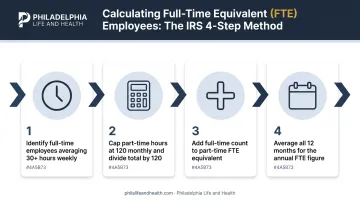
The IRS calculation for determining Applicable Large Employer status works like this:
- Count employees averaging 30+ hours/week (130 hours/month) as full-time
- For part-time staff, cap each person's monthly hours at 120, add them together, then divide by 120
- Add your full-time count to your FTE count for each month
- Average all 12 months to get your annual FTE figure
A restaurant with 20 full-time cooks and servers plus 15 part-timers averaging 60 hours a month could easily cross the 25-FTE line without anyone noticing.
The Three Size Tiers That Matter
| FTE Range | Classification | What It Means |
|---|---|---|
| Under 25 | Tax credit eligible | May qualify for premium tax credits |
| Under 50 | Small employer | No employer mandate, no reporting |
| 50 or more | Applicable Large Employer (ALE) | Mandate and reporting apply |
A few wrinkles worth flagging:
- Aggregation rules require commonly owned or controlled-group businesses to combine employee counts. Own three related LLCs? The IRS may treat them as one employer for ALE purposes.
- State variations exist. Some states, including New York and Vermont, expanded small-group eligibility to 100 employees. Pennsylvania still defines small business as 50 or fewer full-time employees, so confirm your state's threshold before assuming yours.
- Seasonal workers get a narrow exception if they push you over 50 for no more than 120 days a year.
Miscalculating FTEs is one of the most common (and costly) mistakes we see. A business that thinks it has 48 FTEs but actually has 52 could unknowingly walk into mandate territory. This is exactly the kind of number a broker should verify before it becomes a liability, not after a penalty notice arrives.
The Employer Mandate: What 50+ Employee Businesses Must Know
Once you cross the 50-FTE threshold, you become an Applicable Large Employer, and a different set of rules kicks in: the Employer Shared Responsibility Provision.
The three-part penalty test: An ALE risks a penalty if it fails any of these:
- Offer rate: Coverage isn't offered to at least 95% of full-time employees and their dependents
- Minimum value: The plan doesn't cover at least 60% of expected medical costs
- Affordability: Employee contributions exceed the IRS affordability threshold relative to income
Here's the part many owners miss: a penalty only triggers if an employee actually purchases marketplace coverage and receives a premium tax credit. No employee claim, no penalty, even if your coverage technically falls short.
What a penalty actually costs: For plan years beginning in 2026, the IRS employer shared responsibility penalty amounts work out to:
| Violation | 2026 Penalty |
|---|---|
| Not offering coverage at all | Roughly $3,340 per full-time employee annually (excluding the first 30) |
| Offering inadequate coverage | Roughly $5,010 per employee who receives a premium tax credit, capped at the first penalty amount |
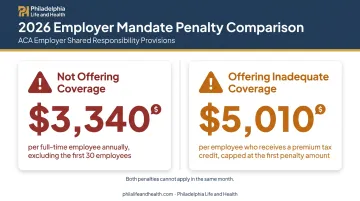
You can't owe both in the same month. But for a 75-employee company, even the lower penalty adds up fast.
Annual reporting requirements: ALEs must file Forms 1094-C and 1095-C documenting the coverage offered to each full-time employee. This isn't optional paperwork. It's how the IRS verifies mandate compliance.
This affects more businesses than owners might assume. Census Bureau data shows businesses with 50-99 employees make up 1.33% of U.S. employer firms, and those with 100+ employees make up another 1.26%. That's a small slice of the total business population, but one carrying the bulk of ACA reporting obligations.
Small Business Tax Credits, SHOP, and ACA Protections for Under-50 Employers
If your business has fewer than 50 FTEs, breathe easier: you're not subject to the employer mandate or its reporting requirements, whether or not you choose to offer coverage.
Who Qualifies for the Small Business Health Care Tax Credit
The credit rewards smaller employers who offer coverage voluntarily. Eligibility generally requires:
- Fewer than 25 FTEs
- Average annual wages below the IRS-set threshold (indexed each year)
- Employer covers at least 50% of employee premium costs
Qualifying businesses can claim up to 50% of premium costs as a credit (35% for nonprofits), generally for two consecutive tax years. Confirm the current wage ceiling before filing, since it adjusts annually.
Protections That Apply No Matter Your Size
Any ACA-compliant plan, regardless of employer size, must include:
- No lifetime or annual dollar limits on essential health benefits
- Coverage of the 10 essential health benefit categories, including maternity care, mental health, and prescription drugs
- No denial or higher pricing based on pre-existing conditions
In practice, this means an employee managing a chronic condition pays the same premium as a healthy colleague of the same age.
SHOP Isn't the Only Path Anymore
The SHOP Marketplace was originally the main vehicle for accessing the tax credit. In practice, enrollment through SHOP has thinned out in many states over the years. Most small businesses we advise now source ACA-compliant, tax-credit-eligible coverage directly through carriers or an independent broker rather than the exchange itself, often with more plan choice and comparable pricing.
Other ACA Compliance Requirements Every Employer Should Know
A few smaller rules apply regardless of size:
- Marketplace coverage notice: Every employer covered by the Fair Labor Standards Act (FLSA) must give this notice to new hires, generally within 14 days of their start date, whether or not the employer offers coverage.
- 90-day waiting period cap: Group plans can't make an otherwise eligible employee wait more than 90 days before coverage starts.
- Summary of Benefits and Coverage (SBC): Employers must provide it at enrollment, renewal, and within 7 business days of a request.
- FSA contribution limits: The IRS adjusts these annually, so verify the current-year cap before open enrollment.
- Wellness program incentives: Employers can offer incentives up to 30% of coverage cost for standard programs, or 50% for tobacco-cessation programs.
None of these carry the financial weight of the employer mandate, but missing them can still create friction during audits or employee disputes.
Choosing the Right ACA Coverage Strategy for Your Business
There's no universal answer here. The right strategy depends on where your business sits relative to the 50-FTE line, your budget tolerance, and what your employees actually want.
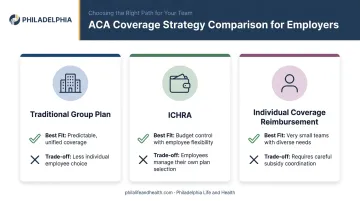
| Strategy | Best Fit | Trade-off |
|---|---|---|
| Traditional group plan | Businesses wanting predictable, unified coverage | Less individual employee choice |
| ICHRA | Employers wanting budget control with employee flexibility | Employees manage their own plan selection |
| Individual coverage reimbursement | Very small teams, diverse employee needs | Requires careful subsidy coordination |
A few factors should guide the decision:
- Proximity to 50 FTEs: Approaching the threshold changes your compliance math fast
- Budget predictability: Group plans offer fixed costs; ICHRA offers a defined contribution with more variability on the employee side
- Employee preferences: Younger, distributed teams often prefer ICHRA-style choice; established teams may prefer a single group plan
This is where an independent broker earns their keep. Philadelphia Life and Health works with businesses of 2-200 employees across the Philadelphia region, comparing group, ICHRA, and tax-credit-eligible options across multiple carriers.
From there, the team handles enrollment, compliance, and renewal strategy year-round, with one goal: keep you out of penalty territory while controlling costs as your business grows.
If you're unsure which side of the 50-FTE line you're on, or whether your current plan still makes sense, contact Philadelphia Life and Health at (215) 544-5432 or group@philalifeandhealth.com for a no-cost review.
Frequently Asked Questions
How does the Affordable Care Act affect businesses with 50 or more employees?
These Applicable Large Employers must offer affordable, minimum-value coverage to at least 95% of full-time staff or risk a shared responsibility penalty. They must also file annual Forms 1094-C and 1095-C with the IRS.
What is the best health insurance option for a small business under the Affordable Care Act?
There's no single best option. It depends on your employee count, budget, and coverage preferences. Group plans, ICHRA, and broker-guided comparisons each fit different situations.
Who is most affected by the Affordable Care Act?
Applicable Large Employers carry the heaviest compliance load. Meanwhile, very small employers and their previously uninsured employees have seen some of the biggest coverage gains under the law.
Do businesses with fewer than 50 employees have to offer health insurance?
No. Businesses with fewer than 50 FTEs are never required to offer coverage under the ACA, though many choose to for recruitment and retention purposes.
What is the Small Business Health Care Tax Credit and who qualifies?
It's a credit covering up to 50% of premium costs for employers with fewer than 25 FTEs, average wages below the IRS threshold, and coverage of at least 50% of employee premiums.
What happens if I miscalculate my full-time equivalent employee count?
Miscalculating FTEs can push you unknowingly into ALE status, exposing your business to reporting requirements and potential penalties. Have a broker or advisor verify the count annually before it becomes a liability.