

Introduction
Shopping for health insurance on your own feels like a maze. Dozens of plans, unfamiliar terms like "actuarial value" and "coinsurance," and a strict calendar that punishes procrastinators.
Miss the deadline, and you could be stuck without coverage for months.
This challenge hits hard in the Philadelphia region. Freelancers, self-employed consultants, early retirees, and part-time workers here often have no employer plan to fall back on. Many aren't sure where to even start looking.
Here's some good news: 48% of adults with ACA Marketplace coverage are self-employed or small-business owners and employees, according to KFF's 2025 analysis. Thousands of people in your same situation have already found coverage this way.
This guide covers who qualifies, when and how to buy, how to pick the right plan, real costs, and how local guidance can simplify the whole process.
Key Takeaways
- Buy coverage through the ACA Marketplace, directly from an insurer, or a free independent broker
- Open Enrollment runs Nov. 1 through mid-January in most states; miss it and you'll need a qualifying life event
- The lowest premium isn't always the best plan—deductibles, networks, and drug coverage matter too
- Premium tax credits can cut your monthly cost if your income qualifies
- Independent brokers like Philadelphia Life and Health compare multiple carriers at no charge
Who Can Buy an Individual and Family Health Insurance Plan?
Individual and family coverage exists for people who fall outside the traditional employer-insurance system. That includes:
- Self-employed workers and freelancers
- Gig workers without benefits packages
- Early retirees not yet eligible for Medicare
- People between jobs
- Part-time employees who don't qualify for a group plan
If you're a U.S. resident, a citizen or lawful resident, and not incarcerated, you can generally buy through the Marketplace. A self-employed person with no employees also qualifies, according to HealthCare.gov's eligibility guidance.
Your income also determines subsidy eligibility. For 2026 Marketplace coverage, premium tax credits are typically available to households earning between 100% and 400% of the federal poverty level. For a family of four, that translates to roughly $32,150 to $128,600 in annual household income.
Once you know you qualify, the next step is finding local guidance you can trust. Philadelphia Life and Health works with individuals and families across Pennsylvania, New Jersey, and Delaware, and holds licensing nationwide. That means the firm can help whether you're a longtime Philadelphia resident or a client whose family recently relocated out of state.
How to Buy an Individual and Family Health Insurance Plan
You have two main paths when buying coverage on your own: the ACA Health Insurance Marketplace, or off-exchange purchases made directly from an insurer or through a licensed broker.
Buying Through the ACA Health Insurance Marketplace
Each state runs its own exchange, or defaults to the federal one:
- Pennsylvania uses Pennie, the Commonwealth's official Marketplace
- New Jersey uses Get Covered New Jersey
- Delaware enrolls through HealthCare.gov
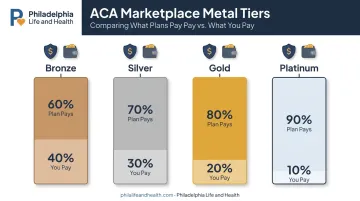
Plans on any exchange are grouped into metal tiers, each representing the share of costs the plan typically covers for a standard population:
| Tier | Plan Pays (Approx.) | You Pay (Approx.) |
|---|---|---|
| Bronze | 60% | 40% |
| Silver | 70% | 30% |
| Gold | 80% | 20% |
| Platinum | 90% | 10% |
During the application, you'll report your estimated household income and size. The exchange uses that data to calculate whether you qualify for a premium tax credit, and applies it automatically if you choose.
Buying Directly From an Insurer or an Independent Broker
You can also buy off-exchange, either straight from a single carrier's website or through a licensed independent broker. There's one catch: premium tax credits are only available through a Marketplace purchase, per HealthCare.gov's glossary. Buying direct from a carrier means forfeiting that subsidy, even if you'd otherwise qualify.
Working with a broker changes the experience without changing your premium:
- A single-carrier purchase locks you into one company's plan lineup
- An independent broker compares plans across multiple carriers, at the same published rates you'd get on your own
- Brokers are paid by the carrier, not the client, so the comparison costs nothing extra
Philadelphia Life and Health follows a three-step model: Educate, Select, Advocate. An advisor first learns your current coverage and needs, then runs a side-by-side carrier comparison and handles enrollment paperwork directly. That's a meaningful difference from a call-center experience where you're routed to whoever picks up.
Enrollment Periods: When You Can Buy
Open Enrollment is the annual window when anyone can sign up, switch, or drop Marketplace coverage. Dates vary slightly by state:
- HealthCare.gov (used by Delaware): November 1 to January 15
- Pennie (Pennsylvania): Extended through January 31 for 2026 coverage
- Get Covered New Jersey: November 1 through January 31
Miss it, and you're generally locked out until next year — unless a qualifying life event triggers a Special Enrollment Period (SEP).
Common SEP triggers include:
- Losing job-based or other qualifying coverage
- Getting married
- Having a baby or adopting a child
- Moving to a new coverage area
- Losing coverage due to divorce or a death in the family
Most SEPs give you a 60-day window to enroll, either before or after the qualifying event, according to HealthCare.gov's Special Enrollment Period guidance.
How to Choose the Right Plan for Your Family
Before comparing plans, take stock of your actual healthcare use. How often does your family see a doctor? Are there ongoing prescriptions or planned procedures on the horizon? A single healthy adult has very different needs than a family of four managing a chronic condition.
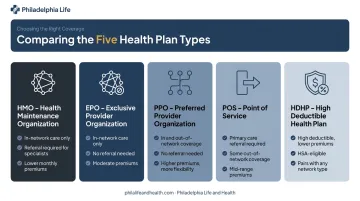
Compare Plan Types: HMO, PPO, EPO, POS, and HDHP
Plan structure affects both cost and flexibility:
- HMO (Health Maintenance Organization): Coverage limited to in-network providers except emergencies. Works well if your preferred doctors are already in-network
- EPO (Exclusive Provider Organization): Similar network restriction to an HMO, without requiring referrals
- PPO (Preferred Provider Organization): Allows out-of-network care without a referral, at higher cost. Best for those who want provider flexibility
- POS (Point of Service): Lower in-network costs, but requires a primary-care referral for specialists
- HDHP (High-Deductible Health Plan): Lower monthly premiums, higher deductible before coverage kicks in. Often paired with an HSA, and suits healthy, low-utilization households
Look Beyond the Premium: Understand Total Cost of Coverage
Choosing a plan type is only half the equation. Premiums are just one piece of the cost puzzle; deductibles, coinsurance, and your out-of-pocket maximum determine what you'll actually spend over the year.
Deductibles have climbed sharply. The average Marketplace deductible for 2026 sits at $3,786 per person, up 37% from $2,759 the year before, according to KFF's analysis of 2026 ACA Marketplace data. A lower-premium plan with a steep deductible can end up costing more if you need care during the year.
Before you buy, take these steps:
- Confirm your doctors are in-network. Skipping this step risks surprise balance billing
- Check the prescription drug formulary. Regular medications may fall into different cost tiers across plans
- Run the subsidy calculation. Many buyers who assume they earn "too much" for help are surprised to find they qualify for a tax credit that lowers the effective monthly cost
Why Work with a Local Independent Broker Like Philadelphia Life and Health
Since brokers are compensated by insurance carriers rather than clients, independent broker services typically cost buyers nothing extra. You get the same premium you'd find buying direct, plus professional guidance thrown in.
That guidance tends to matter most after enrollment, not just during it. Philadelphia Life and Health, operating in the Philadelphia region since 2002, provides:
- Plan selection and side-by-side carrier comparisons
- Direct handling of enrollment paperwork
- Claims support when a bill looks wrong or gets denied
- Annual renewal reviews that re-shop the market on your behalf
Being licensed nationwide while keeping physical offices in Philadelphia and East Norriton lets the firm combine broad market access with the kind of personal service a national call center simply can't replicate.
You get the same advisor on the phone next year, not a random rep pulling up your file for the first time.
If you're weighing your options for individual or family coverage, reach out to the team at (215) 544-5432 or info@philalifeandhealth.com for a no-cost plan comparison.
Frequently Asked Questions
How much does it cost to buy a health insurance plan on your own?
Costs vary widely based on your age, location, and chosen metal tier. Subsidies can cut your net monthly premium if your household income falls within the eligible range.
Can you buy your own health insurance plan?
Yes. Anyone without employer or government coverage can buy an individual or family plan through the Marketplace, directly from an insurer, or through a licensed broker.
Can I just buy health insurance for a month?
Standard individual and family plans require a full plan-year commitment. Short-term medical plans exist in some states for temporary gaps, though they lack many ACA consumer protections.
Is it worth it to buy health insurance?
Yes, in most cases. 62% of uninsured adults report health-care debt, compared to 44% of insured adults, according to KFF's 2026 report on the uninsured population. Preventive care access and potential subsidies often outweigh the monthly cost.
What happens if I miss the Open Enrollment Period?
You'll generally need to wait until next year's Open Enrollment. The exception is a qualifying life event, which triggers a Special Enrollment Period with a typical 60-day window.
Do I need a broker to buy individual health insurance?
No, a broker isn't required. But independent brokers like Philadelphia Life and Health offer free, unbiased plan comparisons and year-round support that self-navigating the Marketplace doesn't provide.