That catches a lot of small and mid-sized employers around Philadelphia off guard. Many assume an ICHRA works like a fully insured group plan, where the carrier handles claims, notices, and paperwork. In reality, ERISA notice deadlines, reimbursement verification, and recordkeeping obligations fall squarely on the employer unless you've built a system to manage them.
This guide breaks down how ICHRA administration actually works, the compliance requirements you're on the hook for, the tasks that repeat every plan year, and how to decide whether to handle it yourself or bring in a local advisor.
Key Takeaways
- ICHRA plans are ERISA-governed, requiring a written plan document, annual notices, and appeals procedures
- Administrators must verify reimbursements, retain records for seven years, and file annual IRS Form 1095s
- DIY administration hides costs: legal fees, staff time, and excise tax risk for noncompliance
- Employers keep plan design control while outsourcing compliance work to a local administrator
What Is ICHRA and How Does Administration Work?
An Individual Coverage Health Reimbursement Arrangement (ICHRA) is an employer-funded benefit that reimburses employees tax-free for individual health insurance premiums and qualified medical expenses. That's the key difference from a fully insured group plan: there's no carrier standing between you and the administrative work.
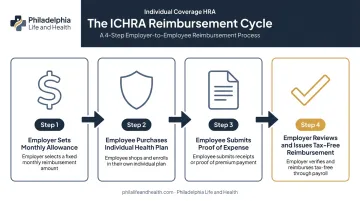
Every ICHRA runs on the same basic cycle:
- Employer sets a monthly allowance by employee class (full-time, part-time, salaried, geographic location, and so on)
- Employee purchases an individual health plan on the marketplace or elsewhere
- Employee submits proof of the premium or medical expense
- Employer or administrator reviews and issues the tax-free reimbursement
Employers can vary allowances using IRS-defined employee classes. Permitted variables include:
- Age, within a defined ratio
- Family size
- Geographic location
This flexibility is regulated: you can't invent your own categories on the fly.
Because there's no insurer processing claims behind the scenes, your business (or your administrator) owns notice distribution, expense verification, and payment issuance directly. Skip a step, and there's no claims department to catch the error before it becomes a compliance problem.
This model is catching on fast. According to HRA Council data, ICHRA adoption grew 34% among applicable large employers and 52% among participating small-employer platforms from 2024 to 2025. As more employers make the switch, the administrative workload grows too: more participants mean more allowances to track, more proof of coverage to verify, and more reimbursements to process correctly.
Compliance Requirements Every ICHRA Administrator Must Manage
An ICHRA is a group health plan under federal law, and that classification carries real legal weight. Running one off a spreadsheet and a handshake invites compliance risk that administrators must actively manage.
Legal Plan Documents and ERISA
Because an ICHRA falls under ERISA, it needs a written plan document that:
- Names the fiduciaries responsible for administration
- Describes funding and reimbursement rules
- Outlines the amendment process
There's no automatic penalty for lacking a plan document. The trouble starts when an employee requests it and you don't have one to hand over.
Requested documents are due within 30 days, and courts can impose fines up to $110 per day after that window closes. Professional drafting support provides that safeguard, giving you a compliant document ready the moment someone asks.
Employee Notice Requirements
Eligible employee classes need written notice at least 90 calendar days before the plan year begins. New hires get a break: notice can go out as late as their first day of coverage.
The notice itself has to cover a fair amount of ground, including:
- Contribution amounts and how they're calculated
- Opt-out rights and the consequences of opting out
- Effect on premium tax credit eligibility
- Medicare interaction rules
- The substantiation and attestation process
Miss a required element, and the notice doesn't satisfy the requirement, even if you technically sent something on time.
Affordability and ACA Alignment
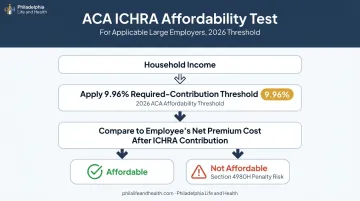
If you're an Applicable Large Employer (50 or more full-time equivalents), your ICHRA needs to be "affordable" based on the lowest-cost Silver plan and employee household income. This keeps you compliant with the ACA employer mandate and out of Section 4980H penalty territory.
For plan years beginning in 2026, the required-contribution percentage is 9.96%, per IRS Revenue Procedure 2025-25. That's your benchmark: if the employee's net premium cost after your ICHRA contribution exceeds that share of household income, the plan isn't affordable, and penalty exposure follows.
Ongoing ICHRA Administration Tasks Employers Must Handle
Setting up an ICHRA is the easy part. What happens every month, and every plan year, is where most self-administered plans start to slip.
Reimbursement review means checking every submission for the service, date, and amount, and confirming the expense qualifies under IRS Section 213(d). No shortcuts here — a missing date or an ineligible expense category can turn a routine reimbursement into an audit flag.
If a claim gets declined, there's a timeline to follow:
- Notify the employee within 30 days of the decision
- Allow 45 days for the employee to supply missing information
- Follow an ERISA-compliant appeals procedure throughout
Recordkeeping and privacy obligations run in parallel. Keep reimbursement records for at least seven years to align with the IRS statute of limitations, and restrict access to protected health information according to HIPAA standards. These obligations demand strict access controls, since exposing protected health information under HIPAA carries real legal risk.
Staff changes add another layer:
- New hires: extend eligibility once any waiting period ends
- Departing employees: settle outstanding reimbursements and end eligibility promptly
- COBRA: applies if you have 20 or more employees, and ICHRAs generally count as group health plans subject to it
Finally, treat these as annual, non-negotiable tasks:
- Reevaluate allowance amounts for the upcoming plan year
- Redistribute required notices before the 90-day deadline
- Complete IRS Form 1095 reporting (1095-C for ALEs, 1095-B for smaller sponsors)
Do this every single year, without exception, or the compliance gaps start compounding.
Self-Administering vs. Partnering with an ICHRA Administrator
Running your own ICHRA sounds straightforward until you tally the real cost. Between legal fees, staff time, and compliance risk, the numbers add up fast:
- Legal fees for drafting IRS-compliant plan documents
- Weekly staff hours spent on notice tracking and reimbursement review
- Exposure to the IRC Section 4980D excise tax, set at $100 per day per affected individual during a noncompliance period
Most small businesses simply don't have dedicated HR or compliance staff tracking evolving IRS and DOL guidance. That gap is exactly where administrative errors creep in, and it's rarely one big mistake. It's usually a missed 90-day notice deadline, or a reimbursement approved without proper substantiation.
Partnering with an independent, local advisory firm offers a middle ground. At Philadelphia Life and Health, employers keep full control over plan design and contribution strategy while offloading the tasks that eat up staff time:
- Notice generation and distribution
- Reimbursement review and substantiation checks
- Ongoing compliance monitoring
You keep the decision-making authority. We handle the paperwork.
What to Look for in an ICHRA Administration Partner
Not every administrator offers the same depth of support. Before signing on, dig into a few specifics:
- Experience and track record: How long has the firm actually managed ICHRAs (not just group benefits in general)? What's their carrier network like?
- Full-service scope: Confirm they handle plan document drafting, annual notices, reimbursement processing, MEC verification, and tax reporting, not just enrollment help
- Year-round availability: Open enrollment support is table stakes. Ask what happens in month seven when an employee has a claims question
Local presence matters more than it might seem. Philadelphia Life and Health operates offices in both East Norriton and Philadelphia, offering hands-on enrollment assistance and claims advocacy well past open enrollment season.

That's a meaningful contrast to call-center vendors, where "support" often means a queue and a case number instead of a person who knows your business.
Frequently Asked Questions
How does the ICHRA work?
The employer sets a monthly allowance by employee class, the employee buys their own individual health plan, submits proof of the expense, and receives tax-free reimbursement up to the allowance amount.
What is the 3:1 rule for ICHRA?
Employers can vary allowance amounts by employee age, but the highest age-based allowance can't exceed three times the lowest allowance offered within the same class.
Can I have both ICHRA and Medicare?
Yes — Medicare-eligible employees can use ICHRA funds to reimburse Medicare premiums. They just can't combine an ICHRA with traditional group health coverage at the same time.
What's the difference between an ICHRA and a QSEHRA?
QSEHRAs are limited to employers with fewer than 50 employees and come with IRS contribution caps ($6,450 self-only, $13,100 family for 2026). ICHRAs are open to any size employer with no contribution limits.
Do small businesses need a third-party administrator for an ICHRA?
It's not legally required, but most small businesses lack the internal expertise to manage the compliance risk without one. A firm like Philadelphia Life and Health typically costs less than the risk of handling that compliance alone.
How long must ICHRA reimbursement records be kept?
At least seven years, matching the IRS statute of limitations for audits related to the plan.