

Introduction
Health premiums keep climbing, and small business owners are noticing. Many employers renewing their group plan this year saw double-digit increases with no changes to coverage or claims history.
That sticker shock is pushing more small and mid-sized companies to ask a question once reserved for Fortune 500 HR departments: should we self-fund our health plan instead?
Here's a common misconception: self-insurance isn't just a big-company strategy. Viable self-funded plans exist for employers with as few as 25 employees, provided they're paired with the right administrator and stop-loss coverage.
This article breaks down what a self-insured health plan actually is, how it compares to a traditional fully-insured policy, the real advantages and risks involved, and how to tell if it fits your business.
Key Takeaways
- Self-insured employers pay claims directly instead of a fixed premium
- ERISA rules exempt self-funded plans from state benefit mandates and premium taxes
- Stop-loss insurance protects against catastrophic claims in both individual and aggregate scenarios
- Small employers with stable claims history can self-fund successfully, too
- Direct claims data reveals cost drivers fully-insured plans often hide
What Is a Self-Insured Health Plan?
In a self-insured (or self-funded) health plan, the employer assumes the financial risk for employee medical claims. Instead of paying a fixed monthly premium to an insurance carrier, the company pays claims directly out of its own funds as they're incurred.
That's the fundamental shift. A fully-insured employer transfers risk to a carrier. A self-insured employer keeps that risk in-house.
Three Ways to Administer a Self-Funded Plan
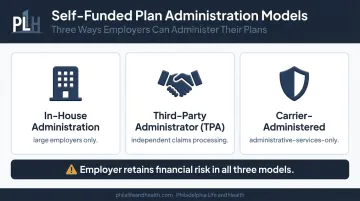
Employers don't have to build claims processing from scratch. There are three common models:
- In-house administration: the employer adjudicates claims internally, typically only feasible for very large organizations with dedicated staff
- Third-party administrator (TPA): an independent firm processes claims, manages provider networks, and handles day-to-day plan operations
- Carrier-administered self-funded solution: a national or regional carrier handles administration on an administrative-services-only basis while the employer remains financially responsible
Here's the part that trips people up: even when a TPA or carrier issues the ID cards, the employer still bears the financial risk. A familiar insurer's logo on an employee's card doesn't mean that insurer is footing the bill. The TPA is administering the plan, not insuring it.
How Common Is Self-Funding Today?
Self-funding is more widespread than many small business owners assume. According to KFF's 2025 Employer Health Benefits Survey, 67% of covered workers nationwide are enrolled in a self-funded plan.
| Employer Size | Share of Covered Workers Self-Funded |
|---|---|
| Small firms (10-199 workers) | 27% |
| Large firms (200+ workers) | 80% |
| All firms | 67% |
That 27% figure among smaller firms shows self-funding isn't exclusively a large-employer arrangement anymore. It's a growing part of the mid-market conversation.
Regulation: How Self-Insured Plans Are Governed
Self-insured plans operate under a different regulatory framework than fully-insured policies, and this distinction matters for cost and compliance planning.
Fully-insured plans answer to state insurance law, while self-funded plans fall under the Employee Retirement Income Security Act (ERISA), a federal law. This means self-insured employers are generally exempt from state-mandated benefits and state insurance premium taxes.
That exemption doesn't mean self-funded plans skip regulation entirely, since several major federal laws still apply:
- ACA (Affordable Care Act) — nondiscrimination rules, preventive care coverage, and cost-sharing limits on essential health benefits
- HIPAA — privacy and security requirements for protected health information (with a narrow exception for very small self-administered plans)
- COBRA — continuation coverage obligations for employers with 20 or more employees
- No Surprises Act — protections against unexpected out-of-network billing, applying to both self-funded and fully-insured employment-based plans
ERISA preemption removes state-level red tape, but it doesn't remove federal responsibility. Employers still need compliance support, whether that's built in-house or through a broker, like Philadelphia Life and Health, who tracks these requirements as part of ongoing self-funded plan consulting.
Self-Insured vs. Fully Insured Health Plans: Key Differences
The core distinction comes down to who holds the risk and how money moves. With a fully insured plan, the employer pays a fixed monthly premium, and the carrier absorbs whatever claims come in. With a self-insured plan, payments track actual claims, and the employer absorbs the swings.
| Factor | Self-Insured | Fully Insured |
|---|---|---|
| Claim payments | Employer pays claims as they occur | Carrier pays claims, employer pays fixed premium |
| Monthly cost predictability | Variable, tied to claims activity | Fixed and predictable |
| State benefit mandates | Generally exempt (ERISA-governed) | Must comply with state mandates |
| State premium tax | Not applicable | Applies, typically 2-3% of premium value |
| Claims data access | Employer receives detailed reporting | Reporting access varies by carrier |
| Plan customization | High — designed around actual workforce | Limited to carrier's standard offerings |
Two differences deserve extra attention.
First, claims data. Self-insured employers typically get direct visibility into claims trends. They can see exactly what's driving costs, whether it's a handful of high-cost claims or a broader utilization pattern. That transparency shapes smarter plan design decisions down the line.
Second, premium tax avoidance. According to a 2025 congressional report on self-insurance, state premium taxes generally run 2% to 3% of premium value, and self-insured employers aren't subject to them. On a $500,000 annual premium spend, that's real money back in the budget.
Self-insured plans also give employers freedom to build coverage around their actual workforce. A company with a younger, healthier staff might add robust preventive benefits and skip costly mandates that don't fit their population, something a standardized fully insured policy can't offer.
Benefits and Risks of Self-Insured Health Plans
Advantages for Employers
Self-funding changes the cash flow equation. Instead of prepaying a fixed premium every month, employers pay claims as they come in and can hold or earn interest on reserved funds in the meantime.
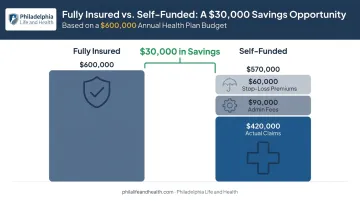
The savings potential shows up clearest in a low-claims year. Consider a hypothetical group with $600,000 budgeted for fully-insured premiums:
- Fully insured: $600,000 paid regardless of actual claims
- Self-funded: $420,000 in actual claims + $90,000 in admin fees + $60,000 in stop-loss premiums = $570,000 total
That's a $30,000 difference retained by the employer purely because claims ran lower than projected. That's the upside case, though. It doesn't always play out this way.
Beyond cash flow, self-funded employers get design flexibility. They can contract directly with preferred provider networks and structure benefits around their actual employee demographics rather than a generic template.
Risks and How to Manage Them
The flip side is unpredictability. In a high-claims year, self-funded costs can exceed what a fully-insured plan would have cost for the same group. A handful of serious diagnoses in a small workforce can swing the numbers fast.
Stop-loss insurance is the primary tool for managing that exposure:
- Individual (specific) stop-loss: reimburses the employer once one person's claims exceed a set attachment point, protecting against a single catastrophic case
- Aggregate stop-loss: caps total claims across the whole group, typically triggered around 125% of expected annual claims
Stop-loss protects the employer, not the employee. The employer remains responsible for plan benefits either way; stop-loss simply limits how much of the tab the company covers itself.
Self-insurance also requires sufficient cash flow and financial reserves, so it's not the right fit for every employer regardless of size. A business with thin margins or unpredictable revenue may find the variability too risky, even with stop-loss in place. Philadelphia Life and Health's self-funded consulting team can model your claims history against both funding approaches before you commit.
Is a Self-Insured Health Plan Right for Your Business?
Self-funding tends to work best for employers who match a specific profile:
- Relatively stable, predictable healthcare utilization year over year
- A desire for more control over plan design and provider networks
- Interest in long-term cost management rather than a quick premium fix
- Sufficient cash reserves to absorb claim fluctuations between reimbursements
Size alone doesn't disqualify a business. SIIA notes that companies with as few as 25 employees maintain viable self-insured plans, particularly when paired with the right TPA and appropriate stop-loss coverage.
Before switching, run the numbers. That means comparing your current fully-insured costs against a projected self-funded model built from:
- Your group's claims history over the past 2-3 years
- Estimated administrative fees from a TPA or carrier
- Stop-loss premium quotes based on your workforce's risk profile
Skipping this comparison is the most common misstep employers make when considering the switch. Numbers on paper and numbers in practice don't always match, and claims history is the closest thing to a crystal ball you'll get.
How Philadelphia Life and Health Helps Employers Evaluate Their Options
Deciding between self-funded, level-funded, and fully-insured coverage isn't a decision to make from a spreadsheet alone. Philadelphia Life and Health works as an independent, carrier-agnostic advisor for small and mid-sized businesses with 2 to 200 employees, comparing funding options side by side rather than steering clients toward one carrier's product.

That independence matters here specifically. A broker tied to one insurer has limited incentive to walk you through self-funding if it means less premium volume for that carrier. An independent advisor doesn't carry that conflict.
Beyond the initial comparison, self-funding brings added administrative responsibility, from compliance filings to renewal strategy. Philadelphia Life and Health provides year-round support that includes:
- Plan design guidance tailored to your workforce
- Compliance support for the federal requirements that still apply
- Renewal strategy built around your actual claims data, not guesswork
If rising premiums have you weighing whether self-funding makes sense for your business, a personalized funding comparison is the logical next step. Reach the team at (215) 544-5432 or group@philalifeandhealth.com to talk through your options.
Frequently Asked Questions
What is a self insured group health plan?
It's a group health plan where the employer, not an insurance carrier, assumes financial risk and pays employee medical claims directly. Administration is often outsourced to a third-party administrator (TPA), but the employer still bears the financial responsibility.
Can individuals buy self insured group health plans?
No. Self-insured plans are employer- or association-sponsored group arrangements, not products individuals purchase directly. Individuals get coverage through their employer's plan or the individual marketplace instead.
Is self-insurance only an option for large employers?
Not anymore. While self-funding is more common among large employers, viable options exist for businesses with as few as 25 employees when paired with proper stop-loss coverage and an experienced TPA.
What is stop-loss insurance and why does it matter for self-funded plans?
Stop-loss insurance protects the employer against catastrophic claims. Individual stop-loss covers one high-cost person, while aggregate stop-loss caps total claims across the entire group.
Who processes claims under a self-insured health plan?
Claims can be handled in-house for very large employers, but most companies outsource this to a third-party administrator (TPA). The TPA manages enrollment, claims processing, and provider network access on the employer's behalf.
What laws must self-insured health plans comply with?
Self-insured plans fall under federal ERISA law and are exempt from state insurance mandates. They must still comply with the ACA, HIPAA, COBRA, and the No Surprises Act.