
Introduction
Maybe you just turned 26 and got dropped from a parent's health plan. Maybe you're starting a new job in Center City, but your benefits don't kick in for 60 to 90 days. Or you retired at 62 and Medicare is still three years away.
These gaps happen constantly, and they leave you exposed to real financial risk if an accident or illness strikes.
Short-term health insurance is one option built specifically for this problem. It's temporary, limited coverage designed to bridge you between two more permanent plans, not to replace comprehensive insurance long-term.
This guide breaks down how these plans actually work, what they cost, what's covered (and what isn't), and the specific rules that apply if you live in Pennsylvania, New Jersey, or Delaware. We'll also flag when a short-term plan is a smart move and when it isn't.
Key Takeaways
- Short-term plans are medically underwritten and exclude pre-existing conditions
- Coverage is available year-round, unlike ACA Marketplace open enrollment
- New Jersey prohibits individual short-term plan sales; Pennsylvania and Delaware permit them with restrictions
- Low-income households may find subsidized ACA plans cheaper than short-term coverage
What Is Short-Term Health Insurance?
Short-term health insurance, sometimes called limited-duration insurance, is temporary medical coverage. It's designed to hold you over between other health plans, not to serve as your primary coverage for years at a time.
Here's the critical distinction: short-term plans are not ACA-compliant. They don't count as minimum essential coverage, and they're exempt from the Affordable Care Act's consumer protections. That means insurers can ask health questions before approving you, and they can decline coverage or exclude specific conditions based on your answers.
How Long Can a Plan Actually Last?
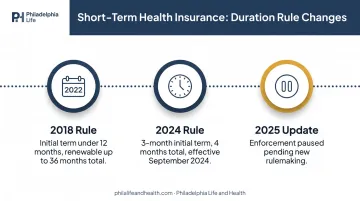
Federal rules on plan duration have shifted more than once in recent years:
- 2018 rule: Allowed an initial term under 12 months, with renewals stretching total coverage to 36 months
- 2024 rule: Cut this down to a 3-month initial term and 4 months total, effective for policies sold on or after September 1, 2024
- 2025 update: Regulators paused enforcement of the 2024 limits while new rulemaking continues, per CMS guidance on short-term, limited-duration insurance
That enforcement pause doesn't erase state law. Wherever your state sets a stricter limit, that limit still controls. Confirm current terms with an advisor before assuming a plan will last as long as advertised — duration is only half the equation, since how insurers screen your application matters just as much.
Medical Underwriting and Post-Claims Review
Unlike ACA plans, short-term applications typically include a health questionnaire. Insurers can also conduct post-claims underwriting, meaning they review your medical history after you file a large claim to check whether a condition existed before your policy started. If it did, they can deny the claim or rescind the policy entirely.
One upside: enrollment isn't restricted to a specific window. You can apply any time of year, unlike ACA Marketplace plans.
Who Should Consider a Short-Term Health Insurance Plan?
Short-term coverage fits a narrow set of circumstances well. Common scenarios include:
- Between jobs — coverage lapsed after leaving an employer, with no new plan lined up yet
- Waiting on a new employer's benefits eligibility period — often 60 to 90 days after a start date
- Aging off a parent's plan at 26
- Missed ACA Open Enrollment — without a qualifying life event for a Special Enrollment Period
- Waiting for Medicare eligibility — after early retirement
Philadelphia Life and Health's advisory team most frequently fields inquiries tied to job transitions and new-employer waiting periods, usually for a 60 to 90 day bridge. Other common callers simply want minimal catastrophic protection for one to six months without committing to a full ACA plan.
What About Visa Holders and International Visitors?
Many visa holders and international visitors pursue temporary or travel medical coverage while in the U.S., though eligibility and terms vary by insurer and visa type. There's no universal rule guaranteeing eligibility, so this is a case where checking directly with an advisor before you travel or arrive matters.
Who Should Think Twice
Short-term plans work best for generally healthy people without ongoing prescriptions or chronic conditions. They're a poor fit if you:
- Have a chronic condition requiring regular treatment
- Are pregnant or planning to become pregnant
- Need predictable, comprehensive coverage for an extended period
Because the right answer depends so heavily on your income, health history, and timeline, compare a short-term plan against ACA subsidy eligibility and employer options before signing anything. This is exactly the kind of comparison an independent advisor can run in a single conversation.
What Does a Short-Term Plan Cover (and Not Cover)?
Coverage varies by carrier and state, but there are clear patterns in what these plans typically include and exclude.
Typically Covered
- Emergency room visits
- Urgent care
- Doctor office visits
- Hospitalization
- Some diagnostic and lab services
Prescription drug coverage is often limited or missing entirely. When it exists, it's frequently a discount card, not actual insurance, meaning you pay a reduced price rather than having the insurer share the cost.
Typically Excluded
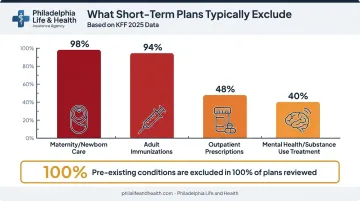
According to KFF's 2025 review of short-term plans, every product examined excluded pre-existing conditions. The same review found:
| Exclusion | Share of plans excluding it |
|---|---|
| Maternity/newborn care | 98% |
| Adult immunizations | 94% |
| Outpatient prescriptions | 48% |
| Mental health or substance use treatment | 40% |
Beyond exclusions, watch for coverage limits. KFF found deductibles ranging from $500 to $25,000 and benefit caps as low as $100,000 per policy term. Some plans have no out-of-pocket maximum at all. Out-of-network care can also trigger balance billing, where you're responsible for the difference between what the insurer pays and what the provider charges.
Before purchasing any specific policy, read the exclusions and limitations section closely. Coverage details differ significantly between carriers, and the marketing brochure rarely tells the full story.
How Much Does Short-Term Health Insurance Cost?
Your total cost comes down to four components:
- Premium: your monthly payment
- Deductible: what you pay before insurance kicks in, and it tends to run much higher than ACA plans
- Coinsurance: your percentage share of costs after the deductible
- Copay: a flat fee for specific services
There's no single national average premium for short-term plans, since pricing swings widely by city, age, sex, and benefit level. KFF's 2025 sample found extra fees stacking on top of base premiums, sometimes pushing a $70 quote past $100:
| Fee Type | Typical Range |
|---|---|
| Base Premium | $70+ monthly |
| Application Fee | $20 – $35 |
| Association Fee | $15 – $25 monthly |
For comparison, CMS reported that Marketplace enrollees paid an average of $113 per month after tax credits in 2025, and 42% of consumers paid $10 or less monthly after subsidies.
That's the catch: because short-term plans don't qualify for any ACA subsidy, a lower-income household might actually pay less for a subsidized Marketplace plan despite its higher sticker price.
A licensed broker can run both quotes side by side in minutes. Our team at Philadelphia Life and Health does exactly that, helping you see which option actually costs less.
Short-Term Plans vs. ACA Marketplace Coverage
The two products solve different problems, and the differences go beyond price.
| Feature | Short-Term Plans | ACA Marketplace Plans |
|---|---|---|
| Enrollment timing | Year-round | Open Enrollment or qualifying life event only |
| Essential health benefits | Not required to cover | Must cover all 10 categories |
| Pre-existing conditions | Can be excluded | Must be covered |
| Subsidy eligible | No | Yes, income-dependent |
One point trips people up regularly: losing short-term coverage does not trigger a Marketplace Special Enrollment Period.
If your short-term plan expires and you haven't had another qualifying event, you may be stuck waiting for the next Open Enrollment window.
It can, however, trigger eligibility for an employer's group plan if a new job is involved.
Short-Term Health Insurance Availability in Pennsylvania, New Jersey & Delaware
State rules make a real difference here, and they're not consistent across our region.
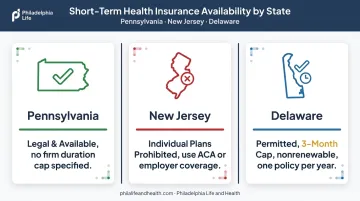
- Pennsylvania: Short-term plans are legal and available. Carriers file forms and rates with the state, but published guidance doesn't specify a firm duration cap, so confirm terms on the specific policy.
- New Jersey: Individual short-term plans cannot be sold here, since regulators ruled the product doesn't qualify as a standard health benefits plan, per a New Jersey Department of Banking and Insurance bulletin. NJ residents should look at ACA Marketplace or employer coverage instead.
- Delaware: Permitted, but capped at a maximum of 3 months total, and the policy must be nonrenewable. You also can't be issued another short-term policy within the same year.
Even where these plans are legal, duration limits, renewability, and covered benefits differ by state regulation. That's exactly why local guidance matters more than a generic online quote tool.
Philadelphia Life and Health is an independent, locally based advisory team with offices in Philadelphia and East Norriton. We help individuals and families across Pennsylvania, New Jersey, and Delaware compare short-term, ACA Marketplace, and employer coverage side by side, so you land on the option that fits your budget and health situation.
If you're weighing a coverage gap right now, reach out through our contact page or call (215) 544-5432. Consultations are free, and we typically respond the same business day.
Frequently Asked Questions
What is the best short-term health insurance plan?
There's no single "best" plan. It depends on your state, health history, and budget. Compare coverage limits and exclusions across carriers, or talk with a licensed advisor first.
Is short-term health insurance worth it?
It can be worth it for healthy people needing a brief bridge in coverage. It's less ideal if you have ongoing health needs or pre-existing conditions, since those gaps in coverage get expensive fast.
Can visa holders get short-term health insurance?
Many visa holders and international visitors can qualify for short-term or travel medical plans, but eligibility and terms vary by insurer and visa type. Confirm specifics before enrolling.
How long can a short-term health plan last?
Duration varies by state and carrier, from as short as one month to several months or longer, depending on current federal and state rules. Delaware caps plans at 3 months; other states differ.
Does short-term health insurance cover pre-existing conditions?
Almost never. Pre-existing conditions are excluded based on a lookback period defined in your specific policy, so read that section carefully before enrolling.
Can I enroll in a short-term plan any time of year?
Yes. Unlike ACA Marketplace plans, short-term coverage can typically be purchased year-round without waiting for an open enrollment period.