Adoption is accelerating. Since the 2020 federal rule change created ICHRA, the HRA Council's 2025 data report found ICHRA adoption among large employers jumped 34% year-over-year, with 83% of employers offering ICHRA or QSEHRA in 2025 having never offered coverage before at all.
Yet confusion persists. Many employers and employees assume an HRA is a type of insurance, or a pre-funded account like an HSA. It's neither. This guide breaks down exactly how an HRA works step-by-step, the types available, and how it stacks up against other benefit structures.
Key Takeaways
- An HRA is an employer-funded reimbursement arrangement, not an account or insurance policy
- Employers set the rules; employees pay first, then submit for tax-free reimbursement
- HRA types (QSEHRA, ICHRA, Integrated, Excepted Benefit) fit different business sizes
- Reimbursements are tax-free when the plan follows IRS rules
- Unused funds may roll over or be forfeited, but never transfer with a departing employee
What Is an HRA?
An HRA is an employer-funded, tax-advantaged benefit arrangement used to reimburse employees for qualified medical expenses and, in many designs, insurance premiums, up to an annual allowance the employer sets. It is not an account.
Under IRS Notice 2002-45, an HRA must be paid solely by the employer, meaning it can't come from employee salary reduction or a cafeteria plan.
That structure solves a real operational gap: businesses that can't afford, or simply don't want, a traditional group health plan still need a compliant way to help employees pay for coverage and care.
What an HRA Is Not
- Not health insurance: it doesn't provide coverage on its own
- Not a pre-funded account like an HSA or FSA
- Not cash: employees can't withdraw funds; they can only be reimbursed for eligible expenses
Despite alternatives like flat stipends or fully insured group plans, HRAs remain popular with small businesses because of the flexibility and tax advantages baked into the design. An employer can set a $300 monthly allowance for one employee class and $500 for another, adjust the rules each plan year, and still get the reimbursements out tax-free.
Several main types exist:
- QSEHRA: for small employers without a group plan
- ICHRA: for employers of any size, split by employee class
- Integrated HRA: paired with an existing group plan
- Excepted Benefit HRA: limited to dental, vision, and similar extras
- One-Person 105 HRA: informal shorthand for very small, owner-only arrangements
Each type has its own reimbursement mechanics, which we'll cover shortly.
How Does an HRA Work?
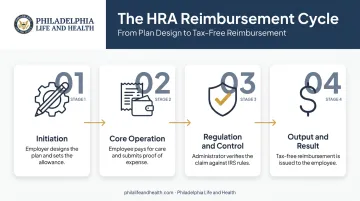
An HRA runs on a defined cycle: the employer sets the terms, the employee incurs an eligible expense, that expense gets verified, and reimbursement follows. Four stages make up this loop.
Initiation
The cycle starts when the employer designs the plan. This means choosing:
- The HRA type (QSEHRA, ICHRA, Integrated, or Excepted Benefit)
- The monthly or annual allowance amount
- Which expenses qualify — premiums, out-of-pocket costs, or both
This stage is manual and employer-driven. Most businesses work with a broker or HRA administrator here, since IRS and ACA compliance requirements shift depending on the HRA type chosen.
Core Operation
Once the plan is live, the employee pays for a qualified expense out of pocket, or through an HRA-linked payment method if the employer's plan offers one. That could be a monthly individual premium or a doctor's visit copay.
Next, the employee submits proof: a receipt, an Explanation of Benefits, or an invoice. This gets sent to the employer or a third-party administrator for review.
Speed matters here — slow claim turnaround is one of the fastest ways to erode employee confidence in a benefit that's supposed to feel simple.
Regulation and Control
Administrators check each submitted claim against IRS Publication 502 guidelines and the employer's specific plan document. Self-certification alone isn't enough; the IRS requires independent verification of the expense, date, and amount.
For ICHRA plans, administrators also track affordability, calculated against the IRS's required-contribution percentage (9.96% for 2026). For QSEHRA, they monitor the annual maximum benefit cap ($6,450 self-only / $13,100 family for 2026). This compliance layer keeps reimbursements tax-free and protects the business from IRS penalties.
Output and Result
The final step: the employer issues a tax-free reimbursement, typically through payroll or direct deposit. Straightforward on the surface, but it has ripple effects.
If an employer's ICHRA or QSEHRA offer is deemed "affordable" under federal standards, it can reduce or eliminate an employee's eligibility for marketplace premium tax credits. That's a detail employees often don't see coming.
Run this cycle consistently, and the payoff shows up in predictable monthly costs for the employer and steadier retention among employees who know exactly what to expect from their benefits.
Types of HRAs and Where They're Used
Not every HRA fits every business. The right type depends on company size, workforce structure, and whether you already offer a group plan.
QSEHRA fits small employers with fewer than 50 full-time equivalent employees that don't offer any group plan. It reimburses premiums, medical costs, or both, and generally must be offered on the same terms to all eligible employees.
ICHRA works differently. It's open to employers of any size, and benefits can be split across employee classes:
- Full-time vs. part-time
- Salaried vs. hourly
- By location or rating area
- Remote vs. in-office staff
That class-based flexibility is part of why ICHRA has become the go-to option for distributed workforces, and why it's the HRA type Philadelphia Life and Health focuses on most closely for its small-business clients.
A few narrower types round out the field:
- Excepted Benefit HRA: reimburses dental, vision, and similar excepted benefits, capped at $2,200 for 2026
- Integrated HRA: paired with an existing group health plan, restricted to cost-sharing and premium reimbursement in most designs
- One-Person 105 HRA: informal shorthand for single-employee arrangements, governed loosely by IRS Notice 2015-17
Choosing the right plan requires matching the design to your specific goals, which is where an independent advisor earns their keep. Philadelphia Life and Health specializes in employers with 2 to 200 employees. Its ICHRA Strategy & Implementation service covers suitability assessment, plan design, contribution strategy, and ongoing compliance support, so businesses aren't left interpreting IRS class rules on their own.
HRA vs. HSA, FSA, and PPO: How It Compares
HRAs often get lumped in with other benefit tools they don't actually resemble. Here's where they diverge:
| Feature | HRA | HSA | FSA |
|---|---|---|---|
| Funding source | Employer only | Employee, employer, or both | Employer, employee, or both |
| Ownership | Employer-owned | Employee-owned | Employer-established |
| Portability | Stays with employer | Moves with employee | Typically forfeited |
| Rollover | Optional, employer's choice | Always rolls over | Use-it-or-lose-it (limited exceptions) |
The portability gap is the one that surprises people most. HSA funds follow the employee for life. HRA funds generally don't move at all; if someone leaves the company, the balance stays behind.
What about a PPO? This comparison gets asked constantly, though it's an apples-to-oranges question. A PPO is a health insurance network structure built around contracted, lower-cost providers, while an HRA is a reimbursement mechanism.
They're not substitutes for each other. An HRA can work alongside:
- A PPO-based plan
- An ICHRA-purchased individual policy
- Nearly any other coverage type, as long as the underlying plan meets integration rules
Tax Benefits and Considerations of HRAs
The tax treatment is a big part of why HRAs remain attractive to small employers.
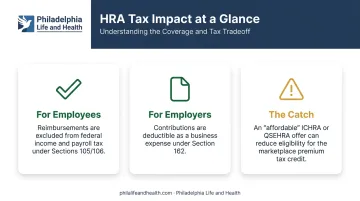
- For employees: Qualified reimbursements are generally excluded from federal income tax and payroll tax when the plan follows IRS rules under Sections 105 and 106.
- For employers: HRA contributions are typically deductible as a business expense under Section 162, adding a cost-management incentive on top of the employee-satisfaction benefit.
- The catch: If an ICHRA or QSEHRA offer is deemed "affordable" under federal standards, it can reduce or eliminate an employee's eligibility for marketplace premium tax credits.
That last point trips up a lot of employees who assume their HRA and a subsidized marketplace plan can be stacked freely. They usually can't, so it pays to run the numbers before open enrollment rather than after. Our team at Philadelphia Life and Health helps small-business clients work through this exact calculation each year.
Conclusion
The logic behind an HRA is simple once you see the cycle: the employer sets the terms, the employee pays and submits, and the employer reimburses tax-free. That structure is exactly what makes HRAs a flexible, cost-controlled alternative to a traditional group health plan, especially for businesses trying to hold the line on rising premiums.
Getting details like plan type, contribution levels, and affordability calculations right is where things get complicated. Philadelphia Life and Health works with employers across Pennsylvania, New Jersey, and Delaware to design, launch, and administer HRAs that fit their budget and workforce, without piling more administrative work onto an already-stretched HR team.
If you're weighing whether an HRA makes sense for your business, reach out to the team for a no-cost conversation.
Frequently Asked Questions
How do I spend my health reimbursement account?
You typically pay for a qualified expense out of pocket first, then submit a receipt or proof of payment to your employer or administrator for tax-free reimbursement. Some plans offer a linked debit card instead.
Is an HRA better than a PPO?
A PPO is an insurance network structure, while an HRA is a reimbursement tool that can complement a PPO or an individual plan. Which one fits best depends on whether the business wants to fund a group plan or reimburse individual coverage.
How does an HRA affect my taxes?
Qualified reimbursements are generally tax-free for employees and deductible for employers. However, an "affordable" ICHRA or QSEHRA offer can reduce your premium tax credit eligibility on the marketplace.
What happens to unused HRA funds at the end of the year?
This depends entirely on employer plan design. Funds may roll over, be capped, or be forfeited if unused, and they stay with the employer if the employee leaves the company.
Can I use an HRA and HSA at the same time?
Certain HRA types, like a limited-purpose or post-deductible HRA, can be paired with an HSA without disqualifying HSA eligibility. A general-purpose HRA typically cannot be combined with an HSA.
What's the difference between QSEHRA and ICHRA?
QSEHRA is limited to small employers under 50 employees with no group plan. ICHRA works for employers of any size and allows benefit amounts to vary by employee class.