Key Takeaways
- Outsourcing payroll offloads wage calculations, tax filings, and compliance monitoring to a specialized provider
- Expect to pay $30 to $100 per employee, per month depending on services and headcount
- Time savings, fewer errors, and stronger compliance are the biggest measurable wins
- Small and mid-sized businesses without dedicated HR staff see the largest relative benefit
- The best providers integrate payroll with benefits, HR, and workers' comp
Introduction
Payroll used to be a back-office chore. Now a single filing error can trigger fines and an audit.
Multi-state hiring, shifting tax rules, and shrinking HR bandwidth have turned payroll outsourcing from a "someday" project into something companies handle in their first year of growth. Most articles talk about this in abstract terms: time savings, cost savings, peace of mind.
But the real value shows up in specifics: fewer payroll corrections, faster turnaround on employee pay questions, and one less audit letter in the mail. The IRS reports that nearly 40% of small businesses face payroll penalties averaging $845 a year. This article breaks down what payroll outsourcing delivers for businesses of every size.
What Is Payroll Outsourcing?
Payroll outsourcing means hiring a third-party provider to calculate wages, withhold taxes, file returns, and manage payments on your company's behalf.
It's typically used by:
- Businesses without a dedicated payroll or HR employee
- Companies expanding into new states with different tax and labor rules
- Organizations that want payroll connected to benefits and HR, not managed separately
Outsourcing is simply the mechanism for freeing up internal time, cutting compliance risk, and managing your workforce well, not just paying it on time.
Key Advantages of Outsourcing Payroll
The advantages below aren't abstract. They tie directly to numbers businesses already track: HR hours per pay cycle, error rates, and total cost of payroll administration. Each one solves a specific operational headache rather than offering a vague promise of "efficiency."
Advantage 1: Significant Time and Administrative Savings
Manually calculating hours, taxes, and deductions every pay period eats into time that could go toward hiring or retention work. Outsourcing removes that burden entirely.
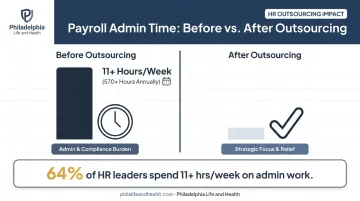
Here's the scale of the problem. A Paychex survey of 600 U.S. business and HR leaders found that 64% spend more than 11 hours per week, over 570 hours a year, on HR administration tasks that include payroll processing, benefits administration, and time tracking.
That's roughly a full extra workday, gone, every single week.
When payroll moves off an HR team's plate:
- Staff shift from data entry and reconciliation to workforce planning
- Turnaround time on employee pay questions drops
- Fewer errors mean less time spent on corrections after the fact
This advantage matters most for: growing businesses, companies with limited HR headcount, and any organization juggling multiple pay schedules across departments or locations.
Advantage 2: Reduced Errors and Stronger Compliance
Payroll providers use trained specialists and automated systems to manage tax calculations, filings, and regulatory updates. In-house teams, especially small ones, often catch up on regulatory changes after they've already caused a problem.
The financial risk is real. The IRS Failure to Deposit Penalty starts at 2% for deposits 1-5 days late and climbs to 10% after 15 days, with interest accruing on top of that. A single missed deadline can turn into a compounding cost.
Outsourcing shifts that monitoring to people whose entire job is tracking these deadlines. The payoff:
- Lower financial exposure from missed filings
- Fewer hours spent untangling correction notices
- Less risk during audits, since records stay organized year-round
Best suited for: multi-state employers, businesses navigating frequent regulatory changes, and any company that's already been burned by a payroll penalty.
Advantage 3: Integration with Benefits Administration and HR
Payroll doesn't operate in a vacuum. When it's synced with benefits deductions and HR records, you get one accurate source of truth instead of three disconnected spreadsheets.
Disconnected systems create real problems: a benefits deduction that doesn't update after an employee changes plans, or an enrollment change that never makes it into payroll. Integration prevents both.
This is where bundled models earn their keep. Philadelphia Life and Health, for example, pairs full-service payroll processing with benefits deduction integration for employers with 2 to 200 employees, connecting payroll to health insurance, HR, and workers' compensation programs.
Instead of managing separate vendors for each function:
- Wage data, classifications, and deduction changes sync automatically across systems
- Fewer vendors mean fewer billing errors and less staff time spent reconciling numbers
Ideal for: companies offering multiple benefit plans, businesses mid-open enrollment, or anyone actively consolidating HR vendors.
What Happens When Payroll Outsourcing Is Ignored
Companies running payroll manually, or with outdated in-house systems, tend to hit the same wall eventually. It usually looks like this:
- Pay inaccuracies pile up. One payroll mistake makes 24% of employees consider leaving; a second pushes that number to 49%, per PayrollOrg's analysis of Kronos survey data.
- Tax withholding and filing errors increase, raising audit risk with every missed deadline.
- Teams shift into firefighting mode during tax season, open enrollment, or whenever regulations change.
- Administrative costs climb as headcount grows or the company expands into new states.
- Scaling becomes harder because there's no dedicated staff to hand tasks off to.
None of this happens overnight. It builds quietly until a missed filing or an angry employee forces the issue.
How to Get the Most Value from Payroll Outsourcing
Outsourcing works best when it's treated as a system, not a task you check off occasionally. A few practices separate companies that get real value from those that just shift the same problems to a vendor.
Review reports every cycle, not just at year-end. Payroll and compliance reports from your provider often show trends, like a recurring overtime spike or a classification mismatch, before they become expensive problems.
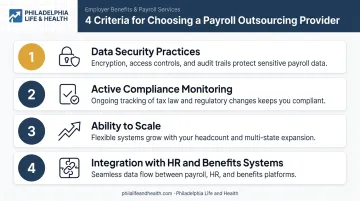
Choose a provider based on four criteria:
- Data security practices, including encryption and access controls
- Active compliance monitoring across federal, state, and local requirements
- Ability to scale as your headcount or state footprint grows
- Integration with your existing HR and benefits systems
Bundle payroll with benefits and HR when possible. Philadelphia Life and Health structures its model around a single point of contact who coordinates payroll, benefits administration through the Ease platform, and HR support through Mineral.
That same advisor also handles workers' compensation, so a small business isn't juggling five separate vendor relationships. The specialized work happens behind the scenes, but the client only ever calls one person.
That consolidation is often what separates a payroll vendor from an actual workforce management partner.
Conclusion
The real value of outsourcing payroll goes beyond cost savings. It delivers control and consistency to a process that touches every employee, every pay period.
Time savings, fewer errors, and stronger compliance don't show up as one-time wins. They compound, especially when payroll is treated as part of a broader benefits and HR strategy rather than a standalone chore.
Outsourcing works best as an ongoing partnership. Not a vendor you switch once and forget about. At Philadelphia Life and Health, payroll fits into a broader benefits and HR strategy for businesses.
Frequently Asked Questions
What are payroll outsourcing services?
These services cover wage calculation, tax withholding, filings, and direct deposit handled by a third-party provider. Many providers, including Philadelphia Life and Health, also integrate payroll with benefits and HR administration.
What is the average cost to outsource payroll?
Costs typically fall between $30 and $100 per employee, per month, according to a Paychex payroll cost report, depending on headcount, pay frequency, and the services included. Fees can rise with added features like multi-state filing or benefits integration.
Is outsourcing payroll a good idea?
For businesses without in-house payroll expertise or facing time and compliance pressure, it's a strong move. The key is choosing a reliable provider with clear compliance and data security practices.
What's the difference between payroll outsourcing and a PEO?
Payroll outsourcing handles processing only, while the business retains its status as employer of record. A PEO takes on co-employment responsibilities, including HR, benefits, and broader compliance obligations.
Is it safe to outsource payroll data to a third party?
Reputable providers use encryption, secure platforms, and recognized security frameworks to protect employee data. Ask any provider about their specific security certifications before signing on.
Can payroll outsourcing be combined with benefits administration?
Yes. Many providers bundle the two together. Philadelphia Life and Health connects payroll with benefits administration, HR support, and workers' compensation for businesses with 2 to 200 employees.