
The Affordable Care Act uses a specific legal term: Minimum Essential Coverage, or MEC. Insurance folks sometimes call these "skinny plans," and that nickname tells you something important about what they do and don't cover.
For growing Philadelphia-area businesses, the confusion around MEC creates real risk. Owners don't know if they're required to offer it, whether their current plan actually qualifies, or how it affects their exposure to ACA penalties.
This guide breaks down what MEC actually is, how it functions for employers, how it differs from Minimum Value (MV) plans, and how to figure out if an MEC strategy makes sense for your business.
Key Takeaways
- MEC is the ACA's baseline coverage standard, not shorthand for comprehensive health insurance
- 50+ FTE employers must offer MEC to avoid a penalty, though full compliance requires more
- Minimum Value is a separate ACA threshold from MEC, with its own rules and penalties
- Standalone MEC plans work best when paired with supplemental or limited medical coverage
What Is Minimum Essential Coverage (MEC)?
Under IRC Section 5000A(f)(1), MEC refers to a defined list of coverage categories: certain government programs, eligible employer-sponsored plans, individual-market plans, and a few other recognized types. It's a legal classification, not a benefit-richness standard.
Here's where it gets confusing. The 2017 Tax Cuts and Jobs Act reduced the federal individual penalty for not having MEC to $0, starting in 2019. But the coverage requirement itself was never repealed, and some states didn't let it go.
New Jersey still enforces its own individual mandate. Residents must maintain MEC, qualify for an exemption, or pay a state-level Shared Responsibility Payment with their state tax return. That payment is capped at the statewide average bronze plan premium.
If you employ New Jersey residents, this matters even if you're not an Applicable Large Employer under federal rules.
There's also a terminology trap worth clearing up. "MEC" as a legal term covers almost everything from Medicaid to a full PPO plan.
But when people ask "what is a MEC in insurance" in a business context, they usually mean something narrower. They're referring to an employer-sponsored limited or "skinny" plan built specifically to satisfy the MEC requirement at a lower cost than traditional group coverage.
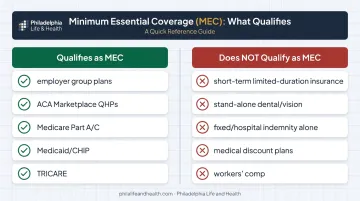
Types of Plans That Qualify as MEC
- Employer-sponsored group health plans, including limited/skinny plans
- ACA Marketplace qualified health plans (QHPs)
- Medicare Part A or Medicare Advantage (Part C)
- Most Medicaid coverage and CHIP
- TRICARE and certain veterans' health coverage
Plans That Do NOT Qualify as MEC
- Short-term, limited-duration insurance
- Stand-alone dental or vision plans
- Fixed or hospital indemnity insurance sold on its own
- Medical discount plans
- Workers' compensation coverage
Notice the pattern: MEC status doesn't say anything about deductibles, hospital coverage, or how good a plan actually is. It only answers one question — does this coverage count at all under the ACA's framework?
How MEC Plans Work for Employers Under the ACA
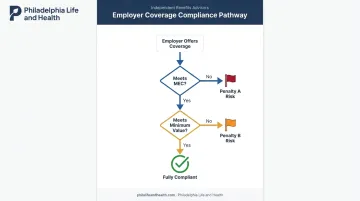
If your business qualifies as an Applicable Large Employer (ALE) — generally 50 or more full-time equivalent employees averaged over the prior year — the ACA's employer mandate kicks in. Specifically, you need to offer MEC to at least 95% of your full-time employees and their dependents.
Fail that threshold, and you risk Penalty A (technically Section 4980H(a)) if even one full-time employee receives a premium tax credit on the Marketplace. For 2026, the IRS set this penalty at $3,340 annually per full-time employee, calculated after excluding your first 30 employees.
A few practical points for employers structuring MEC coverage:
- Employer contributions toward MEC premiums are tax-deductible as a business expense, similar to other employee benefit costs
- Funding can be structured as fully employer-paid, fully employee-paid, or shared between the two
- MEC alone doesn't protect a business from every ACA penalty, as the next section explains
Here's the catch employers miss most often: offering MEC satisfies Penalty A, but it does nothing to protect against Penalty B.
If your coverage is unaffordable or doesn't meet Minimum Value, and an eligible employee still receives a Marketplace subsidy, you're exposed to Penalty B regardless of whether you technically offered MEC. This gap explains why plan design matters just as much as offering coverage at all.
Skinny or MEC-only plans have historically found traction in industries with large part-time or hourly workforces, including:
- Restaurants and food service
- Hospitality and hotels
- Retail and seasonal staffing
That pattern still shows up today wherever businesses run lean on labor costs and need a compliant way to extend some coverage to hourly staff.
MEC vs. Minimum Value (MV) Plans: What's the Difference?
This is where most of the confusion around MEC actually lives. MEC and Minimum Value are not the same test, and mixing them up can cost a business real money.
A plan meets Minimum Value if it covers at least 60% of expected allowed costs for a standard population, and provides substantial coverage for inpatient hospitalization and physician services.
Think of it this way:
- MEC asks: Is this coverage a recognized category under the ACA at all?
- MV asks: Is this coverage actually adequate, meaning it pays a meaningful share of real medical costs?
- Together, they determine: Whether an employer avoids Penalty A, Penalty B, or both.
A plan can absolutely satisfy MEC without ever coming close to meeting MV. That's exactly how skinny plans are designed to work.
These plans are built to clear the MEC bar and avoid Penalty A, while intentionally skipping the deeper coverage MV requires. That gap leaves Penalty B exposure on the table if an employee ends up subsidized on the Marketplace.
That's precisely why many employers pair a base MEC plan with a supplemental or limited medical/hospital indemnity plan. Doing so adds real value for employees, such as help with a hospital stay, an urgent care visit, or a specialist copay, without jumping straight to the cost of full major medical coverage.
| Factor | MEC | Minimum Value (MV) |
|---|---|---|
| What it measures | Whether coverage counts under the ACA at all | Whether coverage pays enough of actual costs |
| Threshold | Falls into a recognized coverage category | Covers 60%+ of allowed costs, plus inpatient/physician care |
| Penalty it relates to | Penalty A (4980H(a)) | Penalty B (4980H(b)) |
| Typical plan example | Skinny/limited employer plan, Medicaid, QHP | Traditional PPO or HMO group plan |
Weighing the Pros and Cons of MEC Plans
Like any cost-control strategy, MEC plans come with real trade-offs worth weighing before you commit.
Advantages
- Lower premium costs compared to traditional group health insurance
- Helps satisfy the ACA's 95% offer requirement, addressing Penalty A exposure
- Employer contributions remain tax-deductible
- Flexible funding — employer-paid, employee-paid, or shared cost structures all work
Disadvantages
- Limited protection. Most plans cover preventive and wellness services only; major medical and hospitalization require supplemental coverage.
- No Penalty B shield. MEC alone doesn't protect against Penalty B if coverage is unaffordable or fails Minimum Value.
- Employee perception risk. A bare-bones MEC plan can feel inadequate next to a traditional plan with real hospital coverage, unless it's paired with a wraparound benefit.
Is an MEC Plan the Right Fit for Your Business?
Key Factors to Consider
Before defaulting to an MEC strategy, walk through a few honest questions:
- What does your workforce actually look like? A high percentage of part-time or hourly employees often points toward MEC as a practical starting point.
- What's your real budget ceiling? MEC plans cost less, but "less expensive" isn't the same as "the right fit" if it leaves gaps employees resent.
- How satisfied are employees with current benefits? If morale around coverage is already shaky, a bare MEC plan alone may make things worse.
- Could a limited medical or supplemental plan close the gap? Layering it with MEC often gives employees more usable coverage without stretching your budget.
How Philadelphia Life and Health Can Help
Deciding between MEC, an ICHRA arrangement, or a traditional group health plan isn't a one-size-fits-all call. It depends on your headcount, your industry, your margins, and what your employees actually value.
As an independent advisor working across multiple carriers, Philadelphia Life and Health helps businesses with 2 to 200 employees compare these strategies side by side. The comparison centers on your compliance needs and budget, not a single carrier's product line.
What sets the approach apart is what happens after enrollment. PLH's account management doesn't stop when open enrollment closes. As your headcount shifts, or renewal season rolls around, the team tracks compliance thresholds and helps adjust plan design so you're not caught off guard by an ACA requirement you didn't know applied.

Frequently Asked Questions
What is a MEC in insurance?
MEC is the ACA's baseline coverage standard — the minimum level of health coverage recognized under federal law. It ranges widely, from Medicaid and Medicare to employer-sponsored skinny plans.
What is the difference between MEC and MVP (Minimum Value) plans?
MEC is the lowest ACA coverage threshold, asking only if coverage counts at all. Minimum Value asks whether a large employer's plan pays at least 60% of allowed costs. A plan can meet one without meeting the other.
What is the MEC Plus Advantage plan?
"MEC Plus" refers to carrier-branded MEC products bundled with extras like limited primary care, telehealth, or hospital indemnity coverage. Specifics vary by carrier, so confirm details with your advisor before assuming what's included.
Do small businesses with fewer than 50 employees need to offer MEC?
No. The ACA's employer mandate only applies to Applicable Large Employers with 50 or more full-time equivalent employees. Smaller businesses can still choose to offer MEC voluntarily.
Is an MEC plan the same as a "skinny plan"?
Yes, "skinny plan" is the common nickname for employer-sponsored MEC coverage that offers only preventive and wellness benefits, without major medical or hospitalization coverage.
Can employees still qualify for Marketplace subsidies if their employer only offers a MEC plan?
Possibly. If the MEC plan is unaffordable or doesn't meet Minimum Value, and the employee isn't enrolled in it, they may still qualify for subsidized Marketplace coverage instead.