

Introduction
Picture this: you're the person who signs the checks, calms down the angriest customer, and keeps the whole operation moving. Now picture what happens to your business, your employees, and your family if you're suddenly not there.
Most small business owners buy personal life insurance to protect their household. Fewer stop to protect the business itself, its debts, its partners, and the people who depend on its paychecks.
This guide walks through the types of business life insurance available and what coverage actually costs. It also covers how tax treatment shifts depending on your business structure, and how to get guidance tailored to your situation.
Key Takeaways
- Business life insurance protects company continuity, not just family income.
- Key person and buy-sell policies solve different problems, and many owners need both.
- A $1,000,000 term policy can cost as little as $24.85 a month for a healthy 30-year-old.
- Tax treatment depends heavily on who owns the policy and who's named the beneficiary.
- Group life plans can double as a low-cost, high-value employee benefit.
Why Small Business Owners Can't Afford to Skip Life Insurance
When an owner dies, the business doesn't just lose a leader. It loses the person who:
- Negotiates with vendors
- Approves payroll
- Holds relationships with your biggest customers
Operations stall almost immediately, and cash flow tightens fast, sometimes within weeks.
That operational strain turns financial fast. Outstanding business loans don't pause for grief, and lenders still expect payment. If you signed a personal guarantee, your family's home, savings, or other assets could be on the line without a financial cushion in place.
This isn't a rare scenario, either.
A 2022 Kreischer Miller survey, published in April 2025, found that 45.9% of Greater Philadelphia family-owned businesses had no formal management succession plan.
That's nearly half of local family businesses with no roadmap for what happens next.
Life insurance won't write a succession plan for you. But it does something a spreadsheet can't: it puts cash in the business's hands at the exact moment it's needed most, buying time for partners, employees, or heirs to figure out the rest.
Types of Life Insurance for Small Business Owners
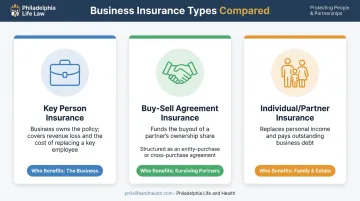
"Business life insurance" isn't one product. It's a category of policies structured to protect your company's continuity, partners, or key employees, rather than simply replacing income for your household. Three structures come up most often for small businesses.
Key Person Life Insurance
The business owns the policy, pays the premiums, and collects the payout. The insured is typically an owner or a critical employee, someone whose absence would genuinely hurt revenue.
If that person dies, the death benefit can cover:
- Lost revenue while the business stabilizes
- Recruiting and training costs for a replacement
- Short-term operating expenses during the transition
For example, a payout might split roughly 60% toward covering revenue gaps and 40% toward funding a new hire's salary and onboarding. The exact split depends on your business and how quickly you can replace that role.
Buy-Sell Agreement Insurance
A buy-sell agreement is a contract that lets surviving business partners buy out a deceased partner's share at a price set in advance. This avoids negotiating with grieving heirs who may not want to run the business.
Life insurance funds that buyout. Two structures exist:
| Structure | How It Works |
|---|---|
| Entity-purchase | The business itself owns policies on each partner and uses the proceeds to buy back the deceased owner's share. |
| Cross-purchase | Each partner owns a policy on the other partner(s) and personally buys the departed owner's share. |
Say two partners co-own a business valued at $2,000,000. Under a cross-purchase setup, each might carry a $1,000,000 policy on the other. If one partner dies, the surviving partner uses that payout to buy the deceased partner's 50% stake directly from their estate, no messy negotiation required.
Individual/Partner Life Insurance
This is more straightforward: partners insure each other, or an owner names their family as beneficiary to replace lost income and pay off business-related debt.
Many owners end up holding two separate policies: one protecting the business or a business partner, and another protecting the family's personal income.
That split matters because business-focused coverage and family income replacement solve two different problems, and rarely does one policy do both jobs well.
Term vs. Permanent Life Insurance: Which Fits Your Business?
Term life insurance covers a fixed window, usually 10 to 30 years, and it's generally the cheaper option. It fits well when you have a specific deadline in mind, like a business loan with a fixed payoff date or a buy-sell agreement tied to a partner's expected retirement age.
Permanent insurance (whole or universal life) lasts your entire lifetime and builds cash value you can borrow against. That makes it useful for open-ended needs: ongoing succession planning, estate planning, or supplementing retirement savings down the road.
Term coverage carries one catch: guaranteed-renewable policies typically continue without a new medical exam, but usually at a much higher attained-age rate.
If you let the term expire and apply for a new policy afterward, you may need fresh underwriting. A health change since your original application could raise your rate significantly.
| Need | Best fit |
|---|---|
| Loan payoff with a fixed timeline | Term |
| Buy-sell agreement tied to retirement age | Term |
| Estate planning or legacy goals | Permanent |
| Cash value for future business needs | Permanent |
Cost shouldn't be the only factor here. Most business owners benefit from sitting down with an independent advisor, like our team at Philadelphia Life and Health, to map out which need each policy is actually solving before picking one based on price alone.
How Much Life Insurance Do You Need — And What Will It Cost?
Sizing coverage for a business owner involves two separate calculations, not one.
First, family income replacement. This is typically calculated as 10 to 15 times your annual salary, the same multiplier used in standard personal life insurance planning.
Second, business protection needs. This one gets overlooked constantly. Add up:
- Payroll obligations if operations pause temporarily
- Outstanding business loans and lines of credit
- Vendor contracts and ongoing obligations
- Rent or mortgage payments on business property
- Cost to recruit and train a replacement for your role
Once you know the dollar figure, the next question is always: what will this actually cost?
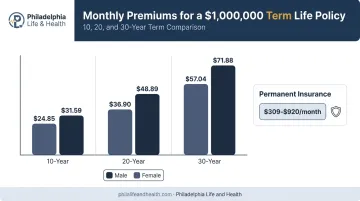
Based on Policygenius' October 2024 carrier data, here's what a $1,000,000 term policy runs for a healthy, nonsmoking 30-year-old:
| Term length | Female | Male |
|---|---|---|
| 10 years | $24.85/month | $31.59/month |
| 20 years | $36.90/month | $48.89/month |
| 30 years | $57.04/month | $71.88/month |
Permanent coverage costs considerably more for the same face amount. That same research shows a $1,000,000 guaranteed universal life policy running roughly $309 to $353 a month, while whole life coverage can run $801 to $920 a month, depending on sex and carrier.
Your actual premium depends on:
- Age and current health
- Smoking status
- Coverage amount requested
- Term vs. permanent structure
- Any riders added to the policy
These numbers are averages, not quotes. Getting real pricing means comparing actual carriers rather than guessing based on industry benchmarks.
Tax Rules and Business Structure: Sole Proprietor, Partnership, LLC, and S-Corp Considerations
Tax treatment hinges on three things: your business structure, who owns the policy, and who's named beneficiary. This is genuinely one of those areas where a tax professional should have the final word, not a blog post.
That said, a few rules apply broadly.
Premiums typically aren't deductible when the business is the beneficiary. Under IRC Section 264(a)(1), the IRS generally denies a deduction for premiums when the taxpayer paying them is also, directly or indirectly, the beneficiary of the policy. That rule applies whether you're structured as a sole proprietorship, partnership, LLC, or corporation.
LLCs can purchase life insurance, such as a key person policy on a critical employee or owner. But that doesn't create a special deduction. Whether an LLC is treated as disregarded (single-member) or as a partnership (multi-member) for federal tax purposes affects how income flows through, though it doesn't override the Section 264 beneficiary rule.
Partners and S-corp owners face an added wrinkle with group-term coverage. The IRS treats partners and S-corp shareholders who own more than 2% of the company as self-employed rather than common-law employees for Section 79 purposes, so the $50,000 tax-free exclusion below doesn't apply to them the way it does for rank-and-file staff.
Group term life insurance is the exception worth knowing. Under IRC Section 79, businesses can generally provide the first $50,000 of group-term coverage to each employee completely tax-free. Anything above that threshold gets added to the employee's taxable income based on IRS premium tables, but that first $50,000 makes group life a low-cost benefit to offer.
Group Life Insurance and Getting Expert Guidance for Your Business
Offering group life insurance is a proven retention tool for small businesses. According to LIMRA's 2025 workplace benefits research, 55% of employees consider life insurance an important workplace benefit, and that number climbs to 61% among Gen Z workers.
Here's the part many small employers miss: you don't need hundreds of employees to qualify. Businesses with just a handful of staff can often access group life coverage, provided they meet the carrier's participation requirements. Those thresholds vary by carrier and plan, which is exactly why comparing options matters.
This is where working with an independent advisor pays off. Philadelphia Life and Health helps small and mid-sized businesses, generally those with 2 to 200 employees, across Pennsylvania, New Jersey, and Delaware navigate both individual business life insurance and group life benefits.
As an independent firm rather than a single-carrier agent, the team compares options across multiple carriers instead of pushing one product.
Common reasons small business owners add this coverage include:
- Funding a buy-sell agreement between partners
- Protecting the business against the loss of a key employee
- Adding group life insurance as an employee benefit
The right structure depends on your specific business, succession plans, and family's needs. Reach out to Philadelphia Life and Health's team for a coverage review built around your actual situation, not a generic template.

Frequently Asked Questions
What is business life insurance?
Business life insurance refers to policies structured to protect a company's continuity, such as key person insurance and buy-sell funding. It's distinct from personal life insurance, which is designed to replace income for your family.
How much does a $1,000,000 life insurance policy cost a month?
For a healthy 30-year-old nonsmoker, term coverage runs roughly $24.85 to $71.88 a month depending on term length and sex. Permanent policies for the same amount cost far more, often $300 to $900+ monthly.
Can I buy life insurance through my LLC?
Yes, an LLC can purchase a policy, such as key person coverage on an owner or essential employee. However, premium deductibility depends on how the LLC is taxed and who's named as beneficiary.
Is life insurance for a small business tax deductible?
Generally, no, premiums aren't deductible when the business itself is the beneficiary. The exception is group term life insurance, which can be offered to employees tax-free up to $50,000 in coverage.
Do sole proprietors need business life insurance?
Sole proprietors typically need coverage focused on replacing personal income and paying off business debts, since there's no partner or key employee structure to insure separately. Family income replacement is usually the priority.
How do I choose the right life insurance policy for my business?
Work with an independent, multi-carrier advisor who can evaluate your business structure, succession goals, and budget. They can then recommend whether term, permanent, key person, or buy-sell coverage fits best.