
Introduction
Group health premiums keep climbing, and many Philadelphia-area employers are running out of patience. In 2025, average employer premiums hit $9,325 for single coverage and $26,993 for family coverage, according to KFF's 2025 Employer Health Benefits Survey.
That's up 5% and 6% from the year before, and small businesses feel the pinch hardest of all.
An Individual Coverage HRA, or ICHRA, offers a different path. Instead of buying a one-size-fits-all group plan, employers fund a tax-free reimbursement account. Employees use it to buy their own individual health insurance.
This article breaks down how ICHRA works, who qualifies, what it covers, and whether it makes sense for your business or household.
Key Takeaways
- ICHRA lets employers of any size reimburse employees tax-free for individual coverage
- No federal cap exists on employer contribution amounts
- Employees must maintain ACA-compliant coverage or Medicare to use the funds
- Businesses can vary contributions fairly across 11 permitted employee classes
- Philadelphia Life and Health advisors can help structure a compliant plan
What Is an Individual Coverage HRA?
An Individual Coverage HRA is an employer-funded account that reimburses employees for individual health insurance premiums and, if the employer chooses, qualified medical expenses. Instead of sponsoring a single group plan, the employer sets a budget. Employees pick their own coverage on the individual market.
This model emerged from a 2019 federal rule issued jointly by the IRS, Department of Labor, and Department of Health and Human Services. The rule opened a compliant path for HRAs to work alongside individual-market coverage.
That path didn't always exist. Earlier ACA guidance from 2013 blocked it, stating that HRAs used to purchase individual plans would fail the ACA's annual dollar-limit and preventive-services rules, according to a 2013 Department of Labor technical release. The 2019 rule closed that gap.
Defined Contribution vs. Defined Benefit
Traditional group plans use a defined benefit approach: the employer picks one plan design, and every enrolled employee gets the same coverage. ICHRA flips this into a defined contribution model, similar to how a 401(k) works for retirement. The employer sets a dollar amount; the employee chooses the plan that fits their needs. A retail business with 15 employees, for example, might set a $350 monthly contribution and let each worker pick a marketplace plan that matches their budget and medical needs.
Despite this flexibility, traditional group coverage still dominates. As of 2025, roughly 165.6 million Americans under 65, or 60% of that population, get insurance through an employer-sponsored plan.
Where ICHRA Fits Among HRA Types
Three main HRA types exist, each with different rules:
- ICHRA – available to employers of any size, no contribution cap
- QSEHRA – limited to employers with fewer than 50 full-time employees, with annual contribution caps
- Excepted Benefit HRA (EBHRA) – offered alongside a group plan, capped, and cannot reimburse individual insurance premiums
ICHRA stands out as the most flexible option. There's no minimum or maximum employer contribution required, and reimbursements are tax-free for both employer and employee.
Who Can Offer an ICHRA?
Any employer can offer an ICHRA, as long as they have at least one common-law W-2 employee. This includes:
- Small businesses and startups
- Nonprofits
- Government entities
- Large corporations with hundreds of employees
There's no size floor or ceiling. A five-person shop and a 500-person company can both use this structure.
How Does an ICHRA Work?
The mechanics are simpler than they sound. An employer sets a monthly allowance, defines which employees qualify, and lets those employees shop for coverage on their own.
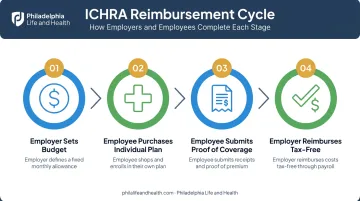
Here's the basic flow:
- Employer sets a budget and decides which employee classes receive it
- Employees purchase an individual market plan (or use existing Medicare)
- Employees submit proof of coverage and premium costs
- Employer reimburses the employee, tax-free, up to the set allowance
The 11 Permitted Employee Classes
Employers don't have to offer the same allowance to everyone. Federal rules allow variation across 11 specific classes, including:
- Full-time and part-time employees
- Salaried and non-salaried employees
- Seasonal workers
- Employees in different geographic locations
- Staffing firm temporary employees
- Employees in a collective bargaining unit
This lets a business give warehouse staff one allowance and remote sales reps another, as long as the structure stays uniform within each class.
Age, Family Size, and Tax Treatment
Contributions can also vary by age and family size within a class. The catch: age-based amounts can't exceed a 3:1 ratio between the oldest and youngest employee. So if a 60-year-old gets $900 a month, the youngest employee in that class must get at least $300.
Reimbursements remain tax-free for both parties, similar to how traditional group premiums are treated.
A Built-In Enrollment Window
Getting newly offered an ICHRA triggers a Special Enrollment Period. Employees generally get 60 days to enroll in a qualifying individual plan, even outside the normal Open Enrollment window, according to CMS guidance. This keeps employees from being stuck waiting months for coverage.
This straightforward setup, paired with a guaranteed enrollment window, is one reason adoption is climbing fast. The HRA Council's 2025 data report found ICHRA adoption rose 18% among small employers and 34% among large employers in a single year across member platforms.
Who Is Eligible for an Individual Coverage HRA?
Eligibility runs on two tracks: what the employer must do, and what the employee must maintain.
Employer-Side Rules
An employer cannot offer both a traditional group plan and an ICHRA to the same class of employees. They also can't let one class choose between the two. Within a given class, terms must be uniform, aside from the permitted age and family-size variations.
Employee-Side Requirements
To use ICHRA funds, an employee (or dependent using the funds) must be enrolled in one of the following:
- ACA-compliant individual health insurance, on or off the exchange
- Medicare Part A and B
- Medicare Part C (Medicare Advantage)
Dependents qualify only if they carry their own individual plan. Coverage through a spouse's employer group plan doesn't count, even if that spouse's plan is excellent.
Certain plan types fail the integration requirement entirely, regardless of who holds the policy:
- Short-term limited duration insurance (STLDI)
- Health care sharing ministry plans
- Fixed indemnity plans
- Excepted-benefits-only coverage, such as standalone vision or dental
A Note on Business Owners
Self-employed individuals, partners, and S-corp owners with more than 2% ownership generally cannot participate as employees under their own ICHRA. The IRS treats these individuals differently than common-law employees for purposes of Section 105.
Sorting out class structure and ownership status can get complicated fast, especially for owner-heavy businesses. Philadelphia Life and Health's team, including advisors like Zachary Ritz who specializes in ICHRA options, helps Philadelphia-area businesses work through these rules before rolling out a plan.
What Does an Individual Coverage HRA Cover?
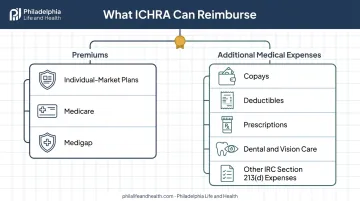
ICHRA funds can reimburse premiums for individual-market health plans, whether purchased on or off the ACA exchange. They can also cover Medicare and Medigap premiums for eligible employees.
Employers aren't limited to premiums alone. They can choose to extend reimbursement to qualified out-of-pocket medical expenses, as outlined in IRS Publication 502. That list includes:
- Copays and deductibles
- Prescription medications
- Dental and vision care
- Other IRC Section 213(d) medical expenses
Here's the key rule: whatever scope an employer picks, premiums only, expenses only, or both, must apply uniformly to everyone within a given employee class. An employer can't quietly give one employee broader coverage than another in the same class.
ICHRA vs. QSEHRA vs. Traditional Group Health Plan
Choosing between these three structures comes down to your business size and how much budget flexibility and compliance protection you actually need.
| Feature | ICHRA | QSEHRA | Traditional Group Plan |
|---|---|---|---|
| Employer size | Any size | Under 50 full-time employees | Any size |
| Contribution cap | None | Capped annually (2026: $6,450 self-only) | N/A |
| Coverage requirement | Individual plan or Medicare | Minimum essential coverage | Enrollment in group policy |
| Satisfies ACA employer mandate | Yes, if "affordable" | No | Yes |
QSEHRA works well for very small employers who don't currently offer any group plan, but the contribution caps limit its usefulness for growing companies.
ICHRA, by contrast, can satisfy the ACA's employer shared-responsibility mandate for large employers, as long as the offer is deemed affordable under IRS rules. QSEHRA doesn't offer that protection.
The trade-off worth weighing: individual market plans often carry narrower networks than group plans. That's a real consideration, especially for employees with established specialists or ongoing care needs.
Is an Individual Coverage HRA a Good Option?
The honest answer is: it depends on your business, your workforce, and your local market.
The Advantages
- Predictable budgeting – set a fixed contribution and stop absorbing renewal shocks
- No minimum participation – unlike some group plans that require a set enrollment percentage
- Portability – employees keep their own individual plan even if they change jobs
- Personalized choice – employees pick coverage that fits their actual needs, not a generic group design
Weighing these upsides against the trade-offs helps clarify whether ICHRA fits your business.
The Drawbacks to Weigh
- Individual market plans often have narrower networks – Marketplace enrollees average in-network access to just 40% of nearby doctors, versus broader access under large-group plans, per KFF's network analysis
- Employees carry more responsibility for shopping and comparing plans
- Funds don't transfer once an employee leaves the company
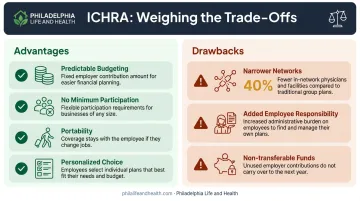
These trade-offs matter more for some employers than others, which is why fit varies by business.
Who Tends to Benefit Most
ICHRA tends to make the most sense for:
- Small businesses offering health benefits for the first time
- Employers hit with steep group renewal increases
- Companies with remote or multi-state teams who struggle to find one group plan that works everywhere
If your team is scattered across Pennsylvania, New Jersey, and Delaware, a single group plan can get complicated fast. ICHRA sidesteps that problem entirely, since each employee buys coverage locally.
Before switching, get a real comparison, not just a sales pitch. Philadelphia Life and Health works as an independent, long-term benefits partner, giving Philadelphia, Pennsylvania, New Jersey, and Delaware businesses objective comparisons across carriers and plan structures.
Frequently Asked Questions
What does an individual coverage HRA cover?
An ICHRA can cover individual health insurance premiums, including Medicare and Medigap premiums. Employers can also choose to reimburse qualified out-of-pocket medical expenses, such as copays and prescriptions.
Is my household eligible for individual coverage HRA?
Dependents qualify for reimbursement only if they're enrolled in their own individual health plan. Coverage through a spouse's employer group plan doesn't meet the integration requirement.
Is an individual coverage HRA a good option?
It depends on your business size, budget goals, and the quality of individual market networks in your area. Speaking with an independent advisor helps clarify whether it fits your specific situation.
Can I cash out my individual coverage HRA?
No. ICHRA funds are strictly for reimbursing qualifying premiums and medical expenses. Any attempt to cash out the funds as taxable income would violate IRS rules governing the arrangement.
How is an ICHRA different from a QSEHRA?
ICHRA has no employer size limit and no contribution cap. QSEHRA, however, is restricted to employers with fewer than 50 full-time employees and comes with annual contribution caps. ICHRA can also satisfy the ACA's employer mandate; QSEHRA cannot.
Can I still get ACA premium tax credits if I'm offered an ICHRA?
Only if the ICHRA offer isn't considered "affordable" under IRS rules. In that case, you can decline the ICHRA and still claim premium tax credits on the Marketplace.