
Many owners struggle with the same issues: limited HR staff, confusing carrier options, and compliance risk tied to ACA and ERISA rules. Renewal season eats up hours nobody has to spare.
This guide breaks down what a group health insurance broker actually does, what it costs (spoiler: usually nothing extra), how to pick one, and what ongoing support should look like once you sign.
Key Takeaways
- Broker compensation is built into carrier premiums, not billed separately to employers
- Brokers compare plans across multiple carriers, unlike captive agents tied to one insurer
- ACA compliance begins at 50 full-time employees, though smaller groups still benefit from brokers
- Strong brokers offer year-round service, not just help during open enrollment
- Philadelphia Life and Health bundles benefits, HR, and payroll for businesses with 2-200 employees
What Is a Group Health Insurance Broker?
A group health insurance broker is a licensed professional who represents the employer, not the insurance carrier. Brokers work across multiple insurance companies to source, compare, and manage health plans on behalf of a business and its employees.
That distinction matters. A broker's job is to find the plan that fits your budget and workforce, not to move product for a single insurer.
How Do Brokers Differ From Insurance Agents in the Group Market?
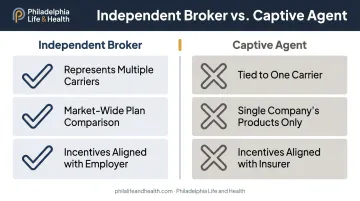
Captive agents sell one carrier's products only. Brokers work independently across carriers, comparing options from regional insurers alongside national names.
For example, a broker in the Philadelphia market might compare plans from a regional carrier like Independence Blue Cross against national players such as Aetna, Cigna, or UnitedHealthcare.
Philadelphia Life and Health runs these side-by-side comparisons across five major carriers, weighing network access, prior authorization rules, and drug tiers before recommending anything.
This independence means the broker's incentive lines up with yours: find the best fit, not the best commission.
How Are Group Health Insurance Brokers Paid?
Most brokers earn a commission built into the plan's premium, paid by the carrier rather than billed to the employer separately. According to NABIP's broker compensation FAQ, this commission-based model is standard across the industry, though some brokers use fee-for-service arrangements instead.
A few things to know:
- Larger or more complex accounts sometimes involve flat consulting fees instead of commissions
- Under Department of Labor rules, brokers expecting $1,000 or more in compensation on an ERISA-covered plan must disclose it to the plan fiduciary
- Ask any broker upfront how they're paid and whether they represent specific carriers with incentive arrangements
Philadelphia Life and Health operates on a carrier-paid model. Their compensation comes from the insurance company, not an invoice to the employer, meaning independent advice comes at no added cost to your business.
Key Benefits of Working With a Group Health Insurance Broker
Brokers earn their keep in ways that go beyond just finding a plan. Here's what a solid broker relationship actually delivers.
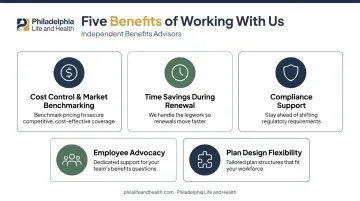
Cost control and market benchmarking. Brokers compare your pricing against similar-sized businesses in your industry, then negotiate with carriers directly.
A 2019 Commonwealth Fund survey found that 69% of small business owners used a broker when selecting benefits, and 92% considered the broker helpful, with over half calling that help "very helpful."
Time savings during renewal. Instead of your HR team juggling RFPs, spreadsheets, and carrier calls, the broker manages that process. That's hours back for owners who are already wearing five hats.
Compliance support. ACA reporting obligations apply once a business becomes an Applicable Large Employer, generally meaning it averaged at least 50 full-time employees, including full-time equivalents, in the prior year. Missing required filings can trigger penalties of several hundred dollars per return under IRS rules.
Brokers help employers track this threshold and stay ahead of ACA, ERISA, and COBRA paperwork.
Employee advocacy. A broker becomes a year-round resource for employees dealing with:
- Enrollment confusion during onboarding
- Claims disputes with the carrier
- Life-event changes like marriage or a new dependent
Plan design flexibility. Beyond traditional fully-insured plans, brokers can bring in level-funded, self-funded, or ICHRA-style arrangements. These options can better match a company's size, cash flow, and risk appetite than a one-size-fits-all group plan.
Group Health Insurance Broker vs. Other Ways to Buy Coverage
Business owners have a few paths to group coverage. Here's how they stack up against working with a broker.
| Option | Pros | Limitations |
|---|---|---|
| PEO | Bundles HR, payroll, and benefits under co-employment | Limited plan customization and carrier choice |
| Direct from one carrier | Simple, single point of contact | No plan comparison; no independent advocate for claims or billing issues |
| Online marketplace | Fast for very basic needs | Little to no support after enrollment closes |
| Independent broker | Multi-carrier comparison, ongoing advocacy | Requires choosing the right partner |
PEOs work well for businesses that want everything handled by one vendor, but that convenience often means fewer carrier options and less flexibility in plan design.
Buying direct from a single carrier cuts out comparison shopping entirely. If a claim gets denied or a bill looks wrong, you're on your own to resolve it.
Marketplaces work similarly for a business with just a handful of employees and simple needs. Once questions get complicated (compliance, plan redesign, employee disputes), that self-service model runs out of runway fast.
Philadelphia Life and Health fills that role, comparing carriers and staying involved after enrollment closes.
How to Choose the Right Group Health Insurance Broker for Your Business
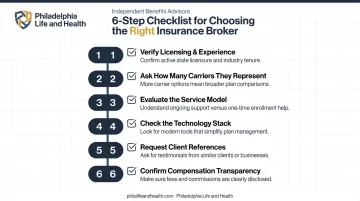
Not all brokers operate the same way. Before signing on, run through this checklist.
- Verify licensing and relevant experience. Confirm the broker holds an active license and has worked with businesses your size, ideally in the 2-200 employee range.
- Ask how many carriers they represent. A broker tied to two or three insurers isn't giving you a market comparison. Also check their knowledge of your local or regional carrier landscape.
- Evaluate the service model. Does support end after enrollment, or does it include year-round account management, claims help, and compliance guidance?
- Check the technology stack. Ask what platforms they use for benefits administration and employee self-service enrollment. Tools like Ease, which Philadelphia Life and Health uses for enrollment and life-event processing, cuts paperwork significantly.
- Request client references. Talk to a current client near your size to gauge responsiveness.
- Confirm compensation transparency. Ask directly whether the broker has any carrier ties that could bias their recommendations.
Skipping this vetting step is how businesses end up with a broker who disappears after open enrollment.
What Ongoing Support Should You Expect From a Group Health Insurance Broker?
A broker relationship shouldn't go quiet the day after enrollment closes.
Year-round account management should cover more than renewal season. That means handling plan changes, answering employee benefit questions, and stepping in when a claim gets stuck or denied.
Annual renewal strategy is where a good broker earns their commission. This includes:
- Benchmarking your current plan against market rates
- Evaluating plan redesigns that could soften cost increases
- Reviewing contribution strategy changes before renewal locks in
Support doesn't stop at insurance placement, either. Bundled HR and compliance resources are increasingly common. Many brokers now pair insurance placement with HR guidance, payroll support, and compliance tools, cutting down the number of vendors a business has to juggle. Philadelphia Life and Health's HR portal, powered by Mineral, gives clients access to HR policies and guidance without hiring a dedicated HR staffer.
Why Small and Mid-Sized Businesses Choose Philadelphia Life and Health
Philadelphia Life and Health has operated as a locally owned, independent employee benefits advisory firm since 2002, with offices in Philadelphia and East Norriton, Pennsylvania. Despite the local roots, the firm is licensed in all 50 states, giving it reach well beyond the Philadelphia region.
That nationwide reach supports a focused niche: the firm specializes in employers with 2 to 200 employees, offering:
- Objective guidance across multiple regional and national carriers
- Bundled HR, payroll, and workers' compensation support alongside insurance placement
- Local, hands-on service rather than call-center handoffs
That local, hands-on service starts at the leadership level. Senior Partner Noah Glassman brings carrier-side experience from AIG, Cigna, and Independence Blue Cross into every client conversation, shaping how the team benchmarks plans and negotiates on a business's behalf.
If your renewal is coming up and the process feels overwhelming, reach out to Philadelphia Life and Health's group benefits team at (215) 544-5432 or group@philalifeandhealth.com for a personalized consultation.
Frequently Asked Questions
Is it cheaper to go through a broker for health insurance?
Broker compensation is typically built into the carrier's premium, so employers generally pay the same price with or without a broker. You get expert guidance and negotiation support at no added cost.
What should I look for when choosing a group health insurance broker?
Look for a broker who represents multiple carriers, understands ACA and ERISA compliance, and offers year-round account support rather than help only at enrollment. Local, independently owned agencies often provide more personalized service than large call-center brokers.
What's the difference between a broker and a captive agent?
A broker represents multiple insurance carriers and can compare plans across companies to find the best fit. A captive agent works for a single carrier and can only offer that company's products.
How many employees do I need to qualify for group health insurance?
Group plans are typically available to businesses with as few as 2 employees, though minimum participation requirements can vary by carrier and state.
Can a broker help with small business health insurance compliance?
Yes. Brokers assist with ACA reporting, ERISA documentation, and COBRA administration, helping employers avoid costly compliance penalties.
How do I switch group health insurance brokers if I'm unhappy with my current one?
You can generally switch at any time, often around renewal, by signing a broker-of-record letter. This transfers servicing rights to the new broker without changing your existing carrier or plan.