
Introduction
Picking a Medicare Advantage plan often comes down to one frustrating trade-off: network restrictions versus cost.
HMO plans keep premiums low but lock you into a specific provider network. PPO plans let you see almost anyone, but you pay for that freedom every month.
That's where HMO-POS plans come in. They're a lesser-known middle ground that borrows structure from HMOs while adding a "Point of Service" option for specific out-of-network care.
In 2026, roughly 6 million Medicare Advantage enrollees, or 46% of all HMO members, were in an HMO-POS plan, according to KFF's 2026 Medicare Advantage analysis. This guide breaks down how these plans work, what they cost, and how they stack up against standard HMO and PPO options.
Key Takeaways
- HMO-POS plans work like an HMO but add limited out-of-network coverage
- Members still need a PCP and typically need referrals for specialists
- Out-of-network care costs more and isn't available for every service
- This plan type sits between HMO (lowest cost) and PPO (most flexible, pricier)
What Is a Medicare Advantage HMO-POS Plan?
HMO-POS stands for Health Maintenance Organization with a Point-of-Service option. It's one of the official Medicare Advantage plan types recognized by CMS, alongside standard HMO, PPO, PFFS, SNP, and MSA plans.
Think of it as a standard HMO with an escape hatch. For most care, members follow typical HMO rules: pick a network PCP, get referrals for specialists, and stay in-network. But the POS "rider" allows access to certain out-of-network providers for services the plan explicitly defines and covers, according to CMS's Medicare Managed Care Manual.
Core structural features of HMO-POS plans:
- Requires selecting an in-network PCP
- Uses a defined provider network for most care
- Includes all Medicare Part A and Part B benefits
- Often bundles extra benefits like vision, dental, and hearing coverage
- Adds a supplemental POS benefit for plan-specified out-of-network services
Don't Confuse It With Employer POS Plans
If you've had employer coverage before, you may remember a commercial "POS" plan, but that's a different animal. Employer POS plans typically use lower in-network cost sharing plus a gatekeeper model for specialist visits. Medicare's HMO-POS is specifically an HMO with a regulated, CMS-defined out-of-network add-on, not a standalone plan category.
Here's the catch: HMO-POS rules vary a lot by carrier. What's covered out-of-network, referral requirements, and cost-sharing amounts differ from plan to plan. There's no universal HMO-POS formula. Reading your plan's Evidence of Coverage document isn't optional. It's the only place you'll find the exact rules that apply to you.
How Do HMO-POS Plans Work?
Most of the time, an HMO-POS plan operates exactly like a standard HMO. You choose an in-network PCP who coordinates your care and issues referrals when you need a specialist. Most visits require that referral, though some exceptions exist, such as annual mammograms.
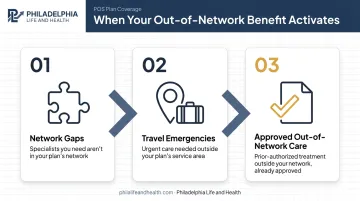
The POS option kicks in during specific situations:
- Network gaps — your plan's network doesn't include a specialist you medically need
- Travel emergencies — you need urgent or emergency care while outside your service area
- Approved out-of-network care — you've obtained prior authorization for medically necessary care outside the network
Even when you use the POS benefit, some out-of-network specialists may still require their own referral from your PCP before treating you.
Prior Authorization Still Applies
Don't assume the POS option means fewer hoops. Prior authorization can still be required for certain services, regardless of whether you're in-network or out. Elective inpatient admissions and outpatient surgeries are common examples.
In fact, 99% of Medicare Advantage enrollees were in plans requiring prior authorization for at least some services in 2026, per KFF's data. Emergency and urgently needed care, however, is exempt — plans can't require prior authorization before treating a true emergency.
What's Typically Covered Out-of-Network (and What Isn't)
Usually covered under the POS benefit:
- PCP and specialist visits (with proper authorization)
- Lab work and diagnostic testing
- Hospital stays for medically necessary care
Usually NOT covered out-of-network:
- Routine dental care
- Routine vision exams
- Routine hearing exams
- Fitness program benefits
One more detail matters: out-of-network providers must accept Medicare and agree to bill your plan directly. Non-contracted providers aren't obligated to treat you at all, except in genuine emergencies. Always confirm this before an appointment, not after.
HMO-POS Costs and Out-of-Network Coverage
HMO-POS costs break down into familiar pieces: a monthly premium, copayments, and coinsurance for in-network care. The wrinkle is a separate, usually higher, cost-share that applies specifically to out-of-network POS services.
Example scenario: Say your in-network coinsurance for a specialist visit is 20%. Your plan's POS benefit might set out-of-network coinsurance at 40% or require a flat, higher copay instead. The exact numbers are entirely plan-specific, so you'll need your plan's Evidence of Coverage to know your real numbers.
For context on overall spending caps, KFF's 2026 benchmarks show:
| Plan Type | In-Network MOOP | Combined MOOP |
|---|---|---|
| HMO (includes HMO-POS) | $4,636 | N/A |
| PPO | $6,592 | $9,825 |
Source: KFF Medicare Advantage 2026 report
Three Exceptions Where You Pay In-Network Rates
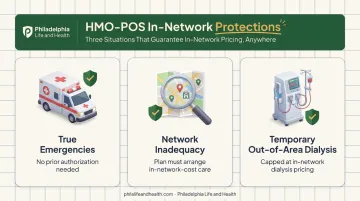
Not every out-of-network claim costs extra. Three situations qualify for protected, in-network pricing regardless of where you receive care:
- True emergencies: cost sharing can't exceed in-network rates, and prior authorization is never required
- Network inadequacy: if a medically necessary covered service isn't available in-network, the plan must arrange it at in-network cost sharing (with prior authorization)
- Temporary out-of-area dialysis: dialysis at a certified facility while you're traveling can't cost more than in-network dialysis
HMO-POS vs. HMO vs. PPO: Which Is Right for You?
HMO-POS vs. Standard HMO
Both plan types require a PCP and referrals for specialist care. The difference is flexibility: standard HMO plans generally don't cover out-of-network care outside true emergencies, urgent care while traveling, or temporary out-of-area dialysis. HMO-POS adds a defined slice of additional out-of-network access on top of that baseline.
That flexibility isn't free. HMO-POS plans can carry a higher premium than comparable pure HMO plans, though the exact difference depends heavily on your carrier and county. KFF's 2026 average for standard HMO premiums sits at $12 per month, but no separate national HMO-POS average currently exists, since KFF folds HMO-POS into its broader HMO category.
HMO-POS vs. PPO
PPOs take flexibility further. There's no PCP requirement and no referrals needed for specialists, in-network or out. That freedom comes at a cost.
| Factor | HMO-POS | PPO |
|---|---|---|
| PCP required | Usually, plan-specific | No |
| Referrals needed | Usually, plan-specific | No |
| Out-of-network access | Limited, defined services only | Broader, usually available for most covered services |
| 2026 average monthly premium | Not separately published | $18 (local PPO) |
If you want lower costs with occasional flexibility for a specific specialist or situation, HMO-POS tends to fit better. Frequent travelers or anyone who wants the freedom to see any provider without asking permission first will likely find a PPO the more comfortable choice, even with the higher price tag.
How to Choose and Enroll in a Medicare Advantage HMO-POS Plan
Timing matters just as much as plan selection. Three enrollment windows apply:
- Initial Enrollment Period (IEP) — a 7-month window around your 65th birthday
- Annual Enrollment Period (AEP) — October 15 through December 7, when you can join, drop, or switch MA plans
- Medicare Advantage Open Enrollment Period — January 1 through March 31, allowing one plan switch for current MA members
Details on each window are available in Medicare's official enrollment guide.
Before you enroll, check:
- Whether your current doctors and specialists are in-network
- What specific out-of-network services the plan's POS benefit actually covers
- What cost-sharing applies to out-of-network POS claims
- Whether prior authorization is required for services you use regularly
Because HMO-POS terms vary so widely by carrier, and even by zip code within the same carrier, comparing plans side by side matters more here than with most other Medicare Advantage types.
The team at Philadelphia Life and Health works with clients across the greater Philadelphia region, including Pennsylvania, New Jersey, and Delaware, to compare HMO-POS options against standard HMO and PPO plans from multiple carriers. If you'd like a plan comparison specific to your area, reach out at (215) 544-5432 or info@philalifeandhealth.com.
Frequently Asked Questions
What does an HMO-POS plan mean in insurance?
HMO-POS stands for Health Maintenance Organization with a Point-of-Service option. It functions like a standard HMO but adds limited coverage for specific out-of-network services.
Is an HMO-POS plan better than a PPO?
It depends on your priorities. HMO-POS plans usually cost less but offer less flexibility, while PPOs cost more but let you see any provider without referrals.
Can you go out-of-network with an HMO-POS plan?
Yes, but only for services the plan specifically covers under its POS benefit, and typically at a higher cost-share. Check your plan's Evidence of Coverage for exact rules.
Do I need a referral to see a specialist with an HMO-POS plan?
Referrals are typically required for in-network specialists. Out-of-network specialists may need their own separate referral before treating you under the POS benefit.
Will I need prior authorization for out-of-network care under an HMO-POS plan?
Some services require prior authorization regardless of network status. Getting authorization in advance helps avoid unexpected bills or denied claims.
Is a Medicare Advantage HMO-POS plan available in my area?
Availability varies by carrier and county. Contact Philadelphia Life and Health or check Medicare.gov's Plan Finder for current-year options available in your zip code.