

Introduction
Picture a Medicare beneficiary juggling insulin schedules, cardiology visits, and a stack of prescriptions for congestive heart failure. Her Medicare Advantage plan works fine for a routine checkup, but it wasn't built around her actual health needs.
Referrals get delayed. Specialist copays add up. Nobody on the plan side seems to be looking at the whole picture.
This scenario is common. Nearly half of Medicare beneficiaries (45%) were managing four or more chronic conditions as of 2022, according to KFF's Medicare policy research. Standard Medicare Advantage plans rarely offer condition-specific coordination for people at that level of medical complexity.
That's where Chronic Condition Special Needs Plans, or C-SNPs, come in. This guide covers what a C-SNP actually is, who qualifies, how it stacks up against a D-SNP, and how to decide whether switching is worth the paperwork.
Key Takeaways
- C-SNPs are Medicare Advantage plans built for people with specific chronic conditions like diabetes, CHF, or ESRD
- A provider must confirm your qualifying condition after enrollment, or you risk disenrollment
- D-SNPs address dual Medicare/Medicaid eligibility, while C-SNPs focus solely on chronic conditions
- Extra benefits often include specialist copay reductions, OTC or healthy food allowances, transportation, and condition-focused drug coverage
What Is a Chronic Condition Special Needs Plan (C-SNP)?
A C-SNP is a type of Medicare Advantage plan that restricts enrollment to people with specific severe, disabling, or chronic medical conditions defined by CMS. You can't just sign up because you like the benefits package. You need a qualifying diagnosis.
Beyond that restriction, a C-SNP functions like other Medicare Advantage plans:
- Covers everything Original Medicare covers under Part A and Part B
- Includes mandatory Part D prescription drug coverage — every SNP is required to offer this
- Comes structured as either an HMO or PPO
- Is only available in certain counties, so a plan that exists in Philadelphia might not exist two counties over
Care Coordination Through a Model of Care
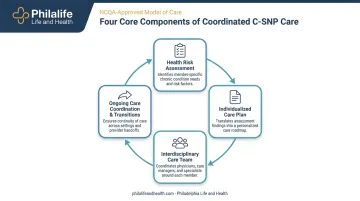
Every C-SNP operates under an NCQA-approved Model of Care (MOC), a framework insurers use to identify and manage each enrollee's specific health needs. In practice, this usually means care runs through a primary care provider who coordinates referrals and specialist access, though the exact referral rules vary by plan. A diabetes C-SNP, for example, might assign enrollees a dedicated case manager who tracks A1C results and flags missed specialist visits before they turn into hospital stays.
Why Insurers Build Plans This Way
Private insurers have historically been wary of covering people with expensive, complex chronic conditions. A C-SNP flips that dynamic. Because the entire plan is designed around a specific condition, the insurer builds in the specialist networks, drug formularies, and supplemental benefits that the population actually needs, rather than offering a generic plan and hoping it fits.
Many C-SNPs also include benefits beyond Original Medicare, such as dental, vision, hearing, or condition-specific supplemental coverage. These extras vary by plan and aren't guaranteed, so always check the Summary of Benefits before assuming a specific perk is included.
Who Qualifies for a C-SNP? Eligibility & Chronic Conditions
Baseline eligibility for any C-SNP requires three things:
- Enrollment in Medicare Part A and Part B
- Residence in the plan's service area — availability depends on your specific ZIP code, not just your state
- A diagnosis matching the plan's qualifying condition
Meeting those three boxes gets you in the door, but there's a verification step that comes right after.
The Verification Requirement
Once you enroll, the plan must contact your physician, physician assistant, or nurse practitioner to confirm your qualifying condition. Here's the timeline that follows:
- End of month one — confirmation from your provider is generally expected by this point.
- First week of month two — if confirmation hasn't arrived, the plan sends you a written notice.
- End of month two — if verification still doesn't come through, disenrollment takes effect.
Don't skip this step. Have your provider ready to confirm your diagnosis as soon as you enroll.
Full List of CMS-Approved Chronic Conditions
CMS recognizes 15 specific chronic conditions for C-SNP eligibility, according to the CMS Chronic Condition Special Needs Plans page. Grouped by type, here's the full list:
Cardiovascular and metabolic conditions:
- Cardiovascular disorders (including coronary artery disease)
- Chronic heart failure
- Diabetes mellitus
- End-stage liver disease
- End-stage renal disease requiring dialysis
Organ and systemic conditions:
- Cancer (excluding pre-cancer conditions)
- Severe hematologic disorders (including sickle-cell disease)
- HIV/AIDS
- Chronic lung disorders (including asthma and emphysema)
- Stroke
Neurological and behavioral health conditions:
- Chronic alcohol and other drug dependence
- Autoimmune disorders (including rheumatoid arthritis and lupus)
- Dementia
- Chronic and disabling mental health conditions (including bipolar disorder and schizophrenia)
- Neurologic disorders (including Parkinson's disease and multiple sclerosis)
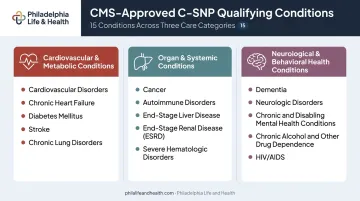
Insurers can also design plans around CMS-approved multi-condition groupings, such as diabetes plus chronic heart failure, or stroke plus cardiovascular disorders. For these standard groupings, having just one of the listed conditions is enough to qualify.
Enrolling Outside the Standard Calendar
Get diagnosed with a qualifying condition in March instead of during the fall enrollment window? You're not stuck waiting. A one-time Special Enrollment Period (SEP) opens up as soon as an appropriate C-SNP is available in your area, and it stays open until you use it.
The reverse applies too. If you no longer meet a plan's qualifying condition, that triggers its own SEP, giving you a window to move to a different Medicare Advantage plan without waiting for the Annual Enrollment Period.
C-SNP vs. D-SNP: What's the Real Difference?
These two plan types get confused constantly, and it's easy to see why. Both are Medicare Advantage Special Needs Plans, both require Part D coverage, and both typically involve a primary care provider. The eligibility path, though, is completely different.
| Factor | C-SNP | D-SNP |
|---|---|---|
| Who qualifies | Beneficiaries with a specific severe/chronic condition | Beneficiaries dually eligible for Medicare and Medicaid |
| Medicaid status | Not required | Required |
| Part D coverage | Mandatory | Mandatory |
| Cost sharing | Standard Medicare Advantage cost sharing, plan-specific | Depends on Medicaid eligibility category; some qualify for zero-dollar cost sharing |
| Primary focus | Condition-specific care coordination and specialist access | Coordinating benefits between two government programs |
A D-SNP exists to smooth out the overlap between Medicare and Medicaid, often resulting in little to no out-of-pocket cost for enrollees who remain dually eligible.
A C-SNP has nothing to do with Medicaid status. It exists purely to organize care and coverage around a specific health condition, whether that's diabetes management, cardiac care, or dialysis support.
Which Plan Applies to You?
- If you're enrolled in both Medicare and Medicaid, start by looking at D-SNPs
- If you have only a qualifying chronic condition and aren't on Medicaid, a C-SNP is the relevant option
- Some beneficiaries qualify for both categories separately and should compare cost structures directly, since they're not interchangeable
How to Enroll in a C-SNP — and Is It Worth It?
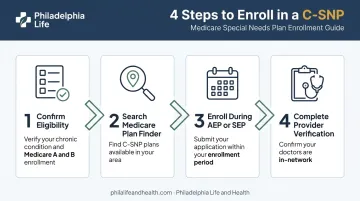
Steps to Enroll in a C-SNP
- Confirm you meet the baseline eligibility — Part A, Part B, service area residence, and a qualifying condition
- Search Medicare's Plan Finder at medicare.gov/plan-compare to see which C-SNPs operate in your ZIP code
- Enroll during the Annual Enrollment Period (October 15 to December 7) or through the SEP tied to your diagnosis
- Complete provider verification promptly so your coverage doesn't lapse
Weighing the Pros and Cons
C-SNPs offer real advantages for the right person:
- Specialized care coordination built around your specific condition
- Provider networks stocked with relevant specialists
- Lower specialist copays in many plan designs
- Added benefits like OTC allowances and transportation assistance in many, though not all, plans
But there are trade-offs worth considering:
- Limited availability — plans exist only in select counties, and yours might not have one
- Network restrictions that can mean switching primary care providers
- Annual condition re-verification that some plans require, adding a recurring administrative step
C-SNP enrollment isn't a niche corner of Medicare Advantage anymore. According to KFF's analysis of Special Needs Plan growth, C-SNP enrollment jumped 71% between 2024 and 2025, accounting for the majority of total SNP enrollment growth that year.
Given the county-by-county variation and the differences between C-SNPs, D-SNPs, and standard Medicare Advantage plans, comparing options on your own can get confusing fast.
Philadelphia Life and Health works with Medicare-eligible individuals across the greater Philadelphia region, offering one-on-one guidance to sort through available plans rather than leaving you to decode carrier websites alone.
You can reach the team at (215) 544-5432 or info@philalifeandhealth.com to talk through your specific situation.
Frequently Asked Questions
What is a C-SNP Medicare plan?
A C-SNP is a Medicare Advantage plan restricted to people with specific severe or chronic conditions. It covers Parts A, B, and D, plus care coordination built around your diagnosis.
What is the difference between C-SNP and D-SNP plans?
C-SNPs are based on having a qualifying chronic condition. D-SNPs are based on dual eligibility for both Medicare and Medicaid. They serve different populations and address different needs.
Are C-SNP plans worth it?
For beneficiaries with a qualifying condition, C-SNPs often deliver better specialist access and added benefits than standard Medicare Advantage plans. Availability and network restrictions vary by plan, so it's best to compare options with a licensed advisor before enrolling.
What chronic conditions qualify for a C-SNP?
CMS recognizes 15 qualifying conditions, including diabetes, ESRD requiring dialysis, chronic heart failure, and chronic lung disorders. Some plans also cover CMS-approved condition groupings.
Can I enroll in a C-SNP outside the Annual Enrollment Period?
Yes. A one-time Special Enrollment Period opens once you're diagnosed with a qualifying condition and an appropriate plan is available. This window stays open until you enroll.
Do C-SNPs cover prescription drugs and extra benefits like dental or vision?
Every C-SNP must include Part D drug coverage. Many also offer dental, vision, hearing, or OTC and healthy food allowances, though these vary by specific plan.