
Pricing swings widely: free DIY tools exist for a handful of workers, while full-service or PEO solutions can run $100 or more per employee monthly. According to QuickBooks' 2026 payroll cost guide, most online payroll services charge a $20-$100+ base fee, with premium all-in-one platforms exceeding $150 a month before adding a single employee.
The real cost depends on your headcount, the service tier you pick, and whether payroll is handled in-house, through software, or fully outsourced. This guide breaks down typical pricing, the line items that inflate your bill, and how to budget correctly for your business size.
Key Takeaways
- Base pricing runs $20-$150/month, plus $4-$25 per employee, based on tier
- Headcount and service level (self-service, full-service, or PEO) drive most cost differences
- Free tools suit tiny teams, but growth requires paid plans with tax filing
- Setup fees, year-end forms, and multi-state filing often show up as surprise charges
- Bundling payroll with HR and benefits through one local partner cuts vendor complexity
How Much Do Payroll Services Cost? (Pricing Overview)
Payroll pricing isn't one-size-fits-all. It scales with your team size, the features you select, and how much compliance work you want a provider to handle for you.
Common mistakes that catch owners off guard:
- Underestimating how per-employee fees compound as headcount grows
- Choosing a free tool that doesn't include tax filing, then scrambling at deadline time
- Missing setup fees or add-on charges that only appear on the first invoice
Typical Cost Ranges
| Tier | Base Fee | Per-Employee Fee | Tax Filing Included? |
|---|---|---|---|
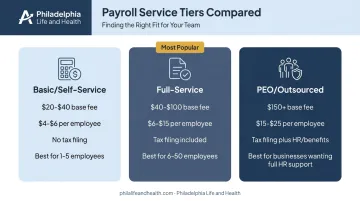
| Basic/self-service | $20-$40/month | $4-$6/month | No |
| Mid-tier/full-service | $40-$100/month | $6-$15/month | Yes |
| Premium/PEO | $150+/month | $15-$25/month | Yes, plus HR/benefits |
Lower tiers exclude automated tax filing and dedicated support. Higher tiers bundle compliance help, HR tools, and benefits administration into one price.
Basic/Self-Service Payroll
What's typically included: wage calculations, direct deposit, and pay stubs. Tax deposits and filings stay on your plate.
Best for: businesses with 1-5 employees where the owner (or a bookkeeper) is comfortable handling quarterly and year-end tax deposits directly.
Full-Service Payroll (Mid-Tier)
What's typically included:
- Automated federal, state, and local tax filing
- W-2 and 1099 generation
- Direct deposit and standard customer support
Best for: growing businesses, roughly 6-50 employees, that want compliance handled without paying for a full HR bundle they don't need yet.
PEO / Outsourced Payroll
What's typically included: a co-employment or bundled outsourcing model covering payroll, HR administration, benefits, and compliance under one contract.
Best for: small businesses that want HR and benefits support comparable to what a much larger company would have in-house.
A local advisory partner can bundle these services instead of leaving you to patch together separate software subscriptions. Philadelphia Life and Health, for example, combines payroll with HR support, benefits administration, and workers' compensation for businesses with 2-200 employees across the Philadelphia region.
Key Factors That Affect the Cost of Payroll Services
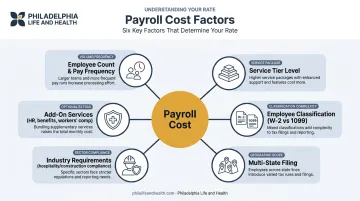
Price depends on several factors, including how many people you're paying, how complex your workforce is, and which features you bolt on.
Number of Employees, Pay Frequency, and Service Level
Per-employee fees scale directly with headcount. Sample full-service software pricing rises from roughly $62-$79/month at 5 employees to $287-$349/month at 50 employees, based on published vendor rate cards.
Pay frequency matters too, but not always in the way owners expect:
- Some providers charge per payroll run, so weekly pay costs more than biweekly or monthly
- Many subscriptions now include unlimited runs, meaning frequency doesn't change your bill
- Always confirm the billing unit before assuming weekly payroll costs more
Beyond headcount and frequency, the service tier you select adds another layer of cost, with each tier stacking more capability on top of the last:
- Basic software: wage math and direct deposit only
- Mid-tier with tax filing: adds automated compliance
- Full-service HR/PEO bundles: adds benefits, HR support, and dedicated account help
Every extra feature, whether it's time tracking, benefits administration, or a dedicated rep, adds incremental monthly cost on top of the base.
Employee Classification, Multi-State, and Industry Requirements
1099 contractors are generally cheaper to process than W-2 employees since there's no tax withholding or employer-side filing involved.
Multi-state employees add real cost. Some providers charge per additional state filed, while others fold multi-state coverage into a higher-tier plan. If your team is spread across Pennsylvania, New Jersey, and Delaware, for instance, confirm whether multi-state filing is included or billed separately.
Certain industries carry built-in compliance overhead on top of classification and location. Hospitality businesses must track tip reporting: employees with $20+ in monthly cash tips are required to report them, and employers calculate withholding on those reported tips. Construction firms working on federally assisted projects face certified payroll requirements, mandating weekly wage documentation under Davis-Bacon rules.
These requirements don't always come with a published surcharge, but they add administrative workload that's worth pricing out directly with a provider.
Add-On Services and Bundled HR/Benefits
Benefits administration, workers' compensation, and broader HR support are usually priced as separate add-ons unless you find a provider that bundles them.
Firms offering combined payroll, HR, benefits administration, and workers' comp support under one contract can reduce total administrative overhead compared to juggling three or four separate vendors. That's the model Philadelphia Life and Health uses for businesses with 2-200 employees, connecting payroll data directly to benefits deductions and workers' comp classifications so nothing needs manual re-entry. Comparing total costs across bundled and standalone providers before signing helps avoid surprise fees, since add-on pricing varies widely for identical services.
Cost Breakdown of Payroll Services
The advertised base price rarely tells the whole story. Here's where the real invoice comes from:
| Cost Item | Billing Type | What It Covers |
|---|---|---|
| Setup/onboarding fee | One-time | Account configuration, data migration, employee enrollment (commonly $0–$200) |
| Base subscription + per-employee fee | Recurring (monthly) | Core payroll processing, direct deposit, basic reporting (typically $20–$150 base plus $4–$12 per employee) |
| Tax filing and compliance | Recurring | Federal, state, and local filing, usually bundled from mid-tier up (often $10–$25/month if billed separately) |
| Add-ons (time tracking, benefits admin, year-end forms) | Recurring/periodic | Optional services, often priced per employee or per form (commonly $2–$10 per employee monthly) |
A quick note on setup fees: some providers waive them entirely to win new business, while others charge up to $200 flat for initial configuration.
Year-end forms follow a similar pattern: many providers charge $5 to $10 per W-2 or 1099, so budget for that separately if it's not bundled into your base plan.
DIY Payroll vs. Outsourced Payroll Services — What's the Difference?
Handling payroll yourself feels cheaper on paper. The real comparison depends on how much your time is worth and how much risk you can absorb.
| Factor | DIY/Free Software | Outsourced Service |
|---|---|---|
| Upfront cost | Lowest, but requires significant owner time | Higher monthly cost, includes automation and support |
| Compliance risk | Higher risk of filing errors and penalties | Many providers offer tax accuracy guarantees |
| Time burden | Several hours per pay period | Frees up owner/staff time |
The time cost is bigger than most owners assume. A Bloomberg Tax survey found that 63% of small business owners underestimated payroll processing time, spending nearly five hours per pay period on it.
Compliance risk is the other side of the coin. IRS penalties escalate quickly for missed deposits:
- 2% penalty for deposits one to five days late
- 10% penalty for deposits over 15 days late
- Trust Fund Recovery Penalty exposure for repeat violations, which can hold a responsible person liable for the full unpaid tax balance
DIY payroll isn't reckless, but it does put that compliance burden squarely on you. Providers that bundle payroll with benefits administration, like Philadelphia Life and Health, can help shift that risk off your plate.
How to Choose the Right Payroll Budget for Your Business
The right payroll spend balances cost against the protection and support your business actually needs, not the cheapest plan on a pricing page.
Factors to weigh:
- Current and projected headcount over the next 1-2 years
- Pay frequency and complexity of classifications (W-2, 1099, multi-state)
- Whether you need bundled HR, benefits administration, and workers' comp, or just payroll processing
- Level of support required — a self-service portal versus a dedicated account rep
- The long-term cost of compliance errors if you pick the cheapest DIY option without adequate backup
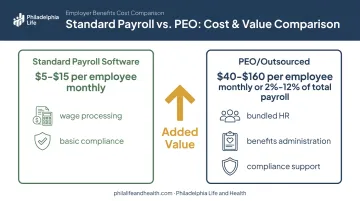
PEO and bundled outsourcing run higher per employee. According to ADP's PEO cost breakdown, administrative fees typically fall between $40-$160 per employee per month, or 2%-12% of total payroll, before benefits and workers' comp are factored in separately.
That premium buys real value if HR and benefits support are things you'd otherwise have to build in-house. Businesses looking for a single local partner to manage payroll alongside benefits and HR, rather than coordinating three separate vendors, may find more value in a bundled advisory relationship.
Philadelphia Life and Health offers exactly that structure to businesses with 2-200 employees across the Philadelphia region, pairing payroll with the Mineral HR platform and Ease benefits administration under one point of contact.
Frequently Asked Questions
How much does it cost for someone to do your payroll?
Payroll services typically run $20-$150 in base fees plus $4-$25 per employee monthly, depending on the tier. CPAs or bookkeepers may instead charge hourly rates or a flat monthly fee for the same work.
What is an example of a payroll fee?
A common example is a $40 monthly base fee plus $6 per employee, or a one-time setup charge paired with a per-form fee for year-end W-2s and 1099s.
Is it cheaper to do payroll myself than to use a service?
DIY payroll saves money upfront, but the time investment and error risk often grow more expensive as your headcount increases. Many owners find the break-even point arrives faster than expected.
Do payroll services charge extra for tax filing?
Basic or free plans usually exclude automated tax filing, leaving deposits and forms up to you. Mid-tier and higher-priced plans typically include tax filing as a core feature.
How much do professional employer organization (PEO) payroll services cost compared to standard payroll software?
PEO administration generally runs $40-$160 per employee monthly, well above standard software's $5-$15 per-employee range. The premium reflects bundled HR, benefits, and compliance support beyond basic processing.
Can I bundle payroll with HR and benefits administration to save money?
Yes. Bundling payroll with HR and benefits through one local partner reduces vendor management and often lowers total administrative overhead compared to juggling separate providers for each function.