Many owners aren't sure where they stand. Which benefits are legally required? Which ones are just expected? And how do you build something competitive without blowing your budget?
This guide breaks down mandatory versus optional benefits, the four main categories to choose from, realistic cost expectations, and how small businesses actually structure a package that works.
Key Takeaways
- Few benefits, like Social Security/Medicare and workers' comp, are legally required for small employers
- Benefits fall into four buckets: health/physical, financial, mental health/wellness, and fringe
- Employee-funded options and tax credits let cash-strapped businesses build competitive packages affordably
- A local broker gives even 5-person startups the carrier access of a Fortune 500 HR team
Are Small Businesses Legally Required to Offer Employee Benefits?
Short answer: most benefits are optional. But a specific set isn't negotiable, no matter how small your team is.
Universally required (with some state-specific exceptions):
- Social Security and Medicare (FICA) — employer and employee each pay 6.2% for Social Security and 1.45% for Medicare, with no employer-size threshold for the basic requirement
- Workers' compensation insurance — required in nearly every state; in Pennsylvania, New Jersey, and Delaware, coverage kicks in for nearly all employers with even one worker
- State unemployment insurance — required once you hit relatively low wage or hiring thresholds (as low as $1,000 in wages paid in New Jersey, for example)
Health insurance is different. The ACA employer mandate only kicks in once you become an Applicable Large Employer, defined as averaging 50 full-time employees plus full-time equivalents in the prior year. Below that threshold, you're not required to offer coverage or pay a penalty for skipping it.
COBRA and Mini-COBRA
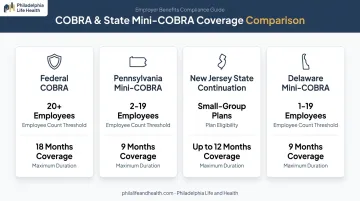
Federal COBRA applies once you cross 20 employees, requiring continued coverage (usually 18 months) for employees who leave. But smaller employers aren't entirely off the hook:
- Pennsylvania mini-COBRA covers employers with 2-19 employees, requiring 9 months of continuation
- New Jersey offers state continuation up to 12 months for small-group plans not subject to federal COBRA
- Delaware mini-COBRA applies to employers with 1-19 employees, up to 9 months
Legally mandated benefits aren't free, either. The Bureau of Labor Statistics puts the national average employer cost for legally required benefits at $3.38 per employee hour worked as of its most recent release. That's before you add a single dollar toward health insurance or retirement.
Even though health coverage isn't mandatory below 50 employees, most small businesses offer it anyway. It's become table stakes for hiring, not a legal checkbox.
What Are the Four Types of Employee Benefits Small Businesses Can Offer?
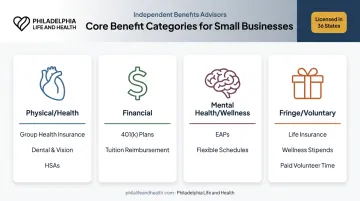
Benefits packages generally pull from four categories: physical/health, financial, mental health/wellness, and fringe/voluntary. You don't need to max out every category. You do need to touch all four to build something well-rounded.
Physical and Health Benefits
This is the category candidates ask about first.
- Group health insurance: the core offering, typically PPO, HMO, or high-deductible plans
- Dental and vision: often sold as standalone add-ons at relatively low cost
- FSAs, HRAs, and HSAs: each shifts costs differently. FSAs use employee-funded pre-tax dollars; HRAs are employer-funded reimbursements; HSAs pair with high-deductible plans and roll over yearly, owned by the employee
- Short- and long-term disability: five states (California, Hawaii, New Jersey, New York, and Rhode Island) legally require short-term disability coverage
Financial Benefits
Retirement plans matter more to candidates than most owners assume, and the government makes it cheaper than expected to offer one.
- 401(k), SEP-IRA, or SIMPLE IRA plans give employees a savings vehicle
- The IRS retirement startup tax credit covers up to 100% of eligible administration costs (for employers with 50 or fewer employees) for the first three years, capped at $5,000 annually
- Financial education, student loan assistance, and tuition reimbursement round out this category
- Cash-constrained startups sometimes substitute equity compensation when cash for salary or benefits is tight
Mental Health and Wellness Benefits
This category has grown fast. 77% of employed U.S. adults reported work-related stress in the prior month, according to the American Psychological Association's 2023 Work in America survey.
- Employee Assistance Programs (EAPs) offer confidential counseling sessions at a relatively low per-employee cost
- Flexible or hybrid schedules cost nothing directly and consistently rank as one of the most valued perks in employee surveys
Fringe and Voluntary Benefits
These round out a package without straining the budget.
- Life insurance (often employer-paid at a modest base amount, with voluntary buy-up options)
- Dependent care FSAs (employee-funded, employer just handles administration)
- Paid volunteer time
- Wellness stipends, gym memberships, or gift card perks
How Much Do Employee Benefits Cost a Small Business?
Numbers help set realistic expectations. According to BLS Employer Costs for Employee Compensation data, private-industry employers pay:
| Cost Category | Employer Cost Per Hour |
|---|---|
| Health insurance | $3.41 |
| Retirement and savings | $1.57 |
| Paid leave | $3.54 |
| Legally required benefits | $3.38 |
| Total benefits | $14.01 |
These are national averages across companies of all sizes, not a small-business-specific quote. These rows don't sum to the total because BLS tracks other benefit types not listed here. Smaller establishments (1-99 workers) tend to run lower, around $9.99 per hour in total benefits costs.
The good news: several benefits carry minimal direct employer cost when structured as employee-funded. Dental and vision premiums can be largely employee-paid, with the employer covering only administrative overhead, and dependent care FSAs work the same way.
Beyond employee-funded benefits, several cost-control strategies can lower your overall spend:
- Bundle multiple insurance lines with one carrier to negotiate better overall pricing
- Offer a high-deductible plan paired with HSAs: lower premiums, employee-owned savings
- Check SHOP marketplace eligibility: businesses with fewer than 25 FTEs and average wages under roughly $67,000 may qualify for a tax credit covering up to 50% of employer-paid premiums
- Work with a broker like Philadelphia Life and Health to benchmark pricing across carriers instead of accepting the first renewal quote
Choosing the Right Insurance and Benefits Options for Your Small Business
There's no universal "best" plan. The right choice depends on your headcount, budget, and what your workforce actually values. That said, most small businesses land on one of these structures:
- Fully insured group plans: predictable premiums, insurer carries the claims risk
- High-deductible plans paired with HSAs: lower premiums, employees build tax-advantaged savings
- Level-funded plans: fixed monthly payments covering expected claims and stop-loss coverage, with the possibility of a refund if claims run low
A growing alternative is the ICHRA (Individual Coverage Health Reimbursement Arrangement), which lets employers reimburse employees for individual-market coverage instead of managing a traditional group plan. Adoption has grown fast: the HRA Council reported 52% growth in ICHRA adoption among smaller employers for the 2025 benefit year.
You generally have three paths to purchase coverage:
- Buying direct from a carrier
- Using the ACA SHOP marketplace
- Working with an independent broker who compares multiple carriers objectively
This is where the size of your business really shapes the right answer.
Philadelphia Life and Health, an independent, locally owned advisory firm, specializes in employers with 2-200 employees. The firm compares plans across five major Pennsylvania carriers, including Independence Blue Cross, Aetna, Cigna, UnitedHealthcare, and AmeriHealth, rather than steering clients toward a single insurer.
Consider a 75-employee law firm weighing three funding models. A fully insured plan offered simplicity but limited cost transparency, while self-funding looked appealing on paper but demanded more internal HR bandwidth than the firm had.
The advisor ultimately recommended a level-funded plan, which balanced predictable monthly costs with the possibility of a year-end refund if claims came in low.
That's the value of ongoing guidance over a one-time policy sale. Coverage needs, carrier pricing, and plan structures shift every year, so having someone review your renewal rather than auto-renewing the same plan can meaningfully change your costs.
Building and Managing a Competitive Benefits Package
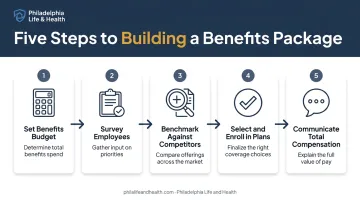
Putting together a package doesn't have to be complicated. It follows a fairly predictable sequence:
- Set a benefits budget based on percentage of payroll or per-employee cost targets
- Survey employees on what they actually value (health coverage, flexibility, retirement match)
- Benchmark against competitors in your industry and region
- Select and enroll in plans that match your budget and workforce priorities
- Communicate total compensation clearly — many employees underestimate the value of benefits unless it's spelled out
Building the package is only half the job: sustaining it without added headcount is where most small businesses struggle. Two approaches cut that workload:
- Automate enrollment and compliance using technology like Ease, which handles employee changes and paperwork without manual work piling up each season
- Pair advisory work with HR support: clients working with Philadelphia Life and Health get Mineral-powered HR resources alongside benefits advisory work, so compliance questions and plan renewals don't require juggling three different vendors
Frequently Asked Questions
What are the four types of benefits?
Most benefits packages draw from physical/health, financial, mental health/wellness, and fringe benefits. A competitive package usually includes at least one offering from each category.
What type of insurance is best for a small business?
It depends on your budget and headcount, but group health plans, HSA-paired high-deductible plans, and ICHRA are common starting points. A broker can help match the right fit to your specific workforce.
Do small businesses have to offer health insurance?
Only employers with 50+ full-time equivalent employees are required to offer it under the ACA. Many smaller businesses still offer it voluntarily to stay competitive for talent.
What is the most affordable benefit a small business can offer?
Flexible or hybrid work schedules cost little to nothing directly. Employee-funded FSAs, dependent care accounts, and EAPs also add value without straining your budget.
Can small businesses get tax credits for offering benefits?
Yes. The small business healthcare tax credit (via SHOP) can cover up to 50% of premiums. The 401(k) startup credit can offset up to $5,000 annually in plan administration costs for three years.
How many employees can a business have and still qualify for small business benefits programs?
Philadelphia Life and Health specializes in employers with 2-200 employees, and most small-business benefits programs fall in a similar range, though eligibility for specific offerings like SHOP varies by rule.