

For small business owners without an HR department, that pressure gets complicated fast. Comparing carriers, staying compliant with ACA and COBRA rules, and managing open enrollment paperwork can eat up weeks you don't have.
This guide breaks down what an employee benefits broker actually does, how they get paid, and what to look for when choosing one for your business.
Key Takeaways
- Brokers work for your business across multiple carriers, not for one insurer's bottom line
- Most brokers earn commissions from carriers, so their guidance costs employers nothing directly
- Strong brokers stay engaged year-round, not just during open enrollment
- Independent, local firms deliver more hands-on service than national call centers
What Is an Employee Benefits Broker?
An employee benefits broker is a licensed professional who sits between your business and insurance carriers. Their job: source, negotiate, and manage benefits packages that can include health, dental, vision, life, and disability coverage.
Brokers evaluate your workforce, shop the market on your behalf, and handle the back-and-forth with carriers so you don't have to. For a 50-employee business, that might mean pulling quotes from a half-dozen carriers in a single week instead of months of solo research. Because they typically hold licenses to work with multiple insurance companies, they aren't locked into pushing one carrier's product.
On compensation: most brokers are paid through commissions built into carrier premiums, according to the National Association of Benefits and Insurance Professionals. Some arrangements involve direct employer fees instead, so confirm the structure upfront. Either way, working with a broker rarely adds a new line item to your budget.
Benefits Broker vs. Insurance Agent
The distinction matters more than most business owners realize:
- Insurance agents represent one carrier and sell that carrier's products exclusively
- Brokers represent your business and compare offerings across many carriers
- Because brokers aren't tied to one insurer, they have no incentive to steer you toward a plan that doesn't fit
If you talk to an agent, you're seeing one slice of the market. A broker shows you the whole shelf.
Benefits Broker vs. Benefits Consultant
These titles overlap more than they used to. Historically, consultants charged flat fees for strategic advice while brokers earned commissions for placing policies. Today, per SHRM's guide to hiring a benefits broker, both compensation models cross labels freely.
Many independent brokers now blend both roles for small businesses, handling plan procurement and offering broader strategic guidance on things like plan design and long-term cost control. Rather than fixating on the title, ask about the actual services and how the firm gets paid.
What Does an Employee Benefits Broker Actually Do?
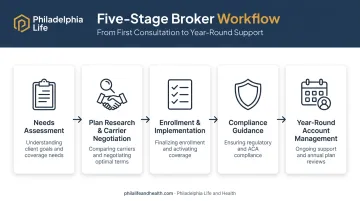
A good broker's work starts well before you pick a plan and continues long after enrollment closes. Here's the typical process:
- Needs assessment – The broker evaluates your company size, employee demographics, budget, and current pain points before recommending anything
- Plan research and carrier negotiation – They shop multiple carriers, compare plan designs, and negotiate rates and terms on your behalf
- Enrollment and implementation – The broker manages paperwork, employee onboarding, and enrollment logistics, taking that burden off your plate
- Compliance guidance – They help you navigate ACA, ERISA, COBRA, and FMLA requirements to avoid missteps. Employers with 50 or more full-time equivalent employees generally must offer affordable, minimum-value coverage under the ACA or risk a shared-responsibility payment, per the IRS.
- Year-round account management – Claims advocacy, renewal strategy, and fielding employee questions continue well after enrollment ends, proving a broker's long-term value.
A broker won't replace your attorney, but they'll flag compliance issues before they become penalties. That ongoing involvement is what separates a true account manager from someone who simply sells a policy and moves on.
Key Benefits of Working with an Employee Benefits Broker
The value shows up in a few concrete ways:
- Cost management – Brokers use carrier relationships and plan-design knowledge to negotiate terms that individual employers often can't secure alone
- Time savings – Outsourcing research, paperwork, and renewal-season logistics frees you up to actually run your business
- Access to expertise without new hires – Small businesses get benefits guidance comparable to what a large company's HR department would provide
- Compliance protection – Reduces your exposure to costly penalties or claims tied to missed regulatory requirements
- Flexibility as you grow – Brokers can layer in voluntary benefits, ICHRA options, or expanded leave policies as your workforce changes
The market itself reflects how much demand exists for this kind of support. The U.S. insurance brokerage market for employee benefits was valued at $34.74 billion in 2022 and is projected to reach $70.11 billion by 2032, according to Allied Market Research. That growth reflects a simple calculation: more employers are choosing broker support once they realize it costs nothing out-of-pocket, since brokers are paid through carrier commissions rather than client fees.
Choosing the Right Broker: Types & Evaluation Criteria
Not all brokers operate the same way. Understanding the structure behind the firm helps you set realistic expectations.
Types of Benefits Brokers
| Broker Type | Typical Strengths | Typical Trade-offs |
|---|---|---|
| National | Broad carrier networks, scale | Less personalized, call-center-based support |
| Regional | Localized market knowledge, flexibility | Coverage may be limited to certain states |
| Independent | No carrier ties, objective advice | Size varies widely by firm |
None of these labels guarantee a specific service level on their own. What matters is what a firm actually delivers.
What to Look for When Evaluating a Broker
Ask these questions before signing on:
- Do they have experience with businesses of your size and industry?
- Are they transparent about carrier relationships and how they stay objective?
- Do they offer year-round service, meaning claims advocacy and renewal strategy, not just a one-time enrollment push?
- Can they provide integrated tools for benefits administration, HR, and payroll so you're not juggling five different vendors?
A broker who checks these boxes acts as an extension of your team, not just a vendor. Philadelphia Life and Health applies that same standard for the small and mid-sized businesses we serve, combining independent guidance with local account management and integrated benefits, HR, and payroll tools.
Why Philadelphia-Area Businesses Choose an Independent, Local Broker
National call-center brokers can process a lot of accounts. What they often can't do is pick up the phone and know who you are.
Philadelphia Life and Health operates as a locally owned, independently operated firm with two offices in the greater Philadelphia region: one in Philadelphia proper and one in East Norriton, PA. That local footprint means:
- Same-day response from an advisor who already knows your account
- In-person meetings when a phone call isn't enough
- Personalized account management instead of a rotating call queue
That local, hands-on model shapes who the firm serves best: businesses with 2 to 200 employees. The firm also holds licenses across all 50 states, covering clients based in Pennsylvania, New Jersey, and Delaware who later expand elsewhere.
Beyond group health placement, the firm's services include:
- ICHRA plans and self-funded consulting
- Medicare guidance and individual coverage
- HR support and payroll administration
- Workers' compensation
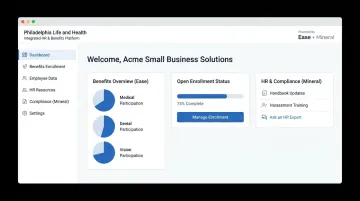
These services run on benefits administration technology through Ease and HR resources powered by Mineral. That combination means fewer vendors to manage and one point of contact who understands the full picture of your benefits strategy.
If your current setup feels more transactional than strategic, a second opinion costs nothing. Contact Philadelphia Life and Health for a no-cost consultation, or call (215) 544-5432 to talk through your options directly.
Frequently Asked Questions
What are the benefits of working with an insurance broker?
Brokers save time and money by comparing multiple carriers instead of one, negotiating terms on your behalf, and flagging compliance risks. You get expert, unbiased guidance without adding headcount.
How does a benefits broker get paid?
Most brokers are paid through commissions built into insurance premiums, so their services come at no direct cost to the employer. Some arrangements involve employer fees instead, so ask upfront which model applies.
What size business needs an employee benefits broker?
Businesses of nearly any size can benefit, but brokers are especially valuable for small to mid-sized companies, roughly 2 to 200 employees, that don't have dedicated in-house HR or benefits staff.
Can I switch benefits brokers without changing my insurance plans?
Yes, typically. Employers can usually switch the broker of record while keeping the same carrier and plans in place, often with minimal disruption to employees.
Is a benefits broker the same as going directly to an insurance carrier?
No. Going direct limits you to one carrier's offerings, while a broker compares multiple carriers to find the best fit and negotiates on your behalf.
Do benefits brokers only help during open enrollment?
Reputable brokers provide year-round support, including claims advocacy, compliance updates, and renewal strategy. Enrollment season is just one part of the relationship.