59% of firms with 10 to 199 workers offered health benefits in 2025, according to KFF's Employer Health Benefits Survey, with the share climbing to 89% once a company reaches 50 or more employees. That gap tells you something: the businesses that figure out group coverage early tend to compete better for talent later.
This guide breaks down what a group health plan actually is, why it matters for hiring and retention, the three main plan types, what eligibility and costs look like, and how to choose the right fit for your team.
Key Takeaways
- Group plans pool employees under one policy, lowering costs through shared risk
- Employers usually pay the larger premium share, though splits vary by plan
- HMO, PPO, and HDHP/HSA plans differ mainly in network flexibility and cost-sharing
- Plan choice should match your budget, workforce size, and compliance needs, not popularity
What Is a Group Health Plan?
A group health plan is coverage an employer purchases for a group of employees under a single policy. It's different from an individual marketplace plan, where each person shops and pays on their own.
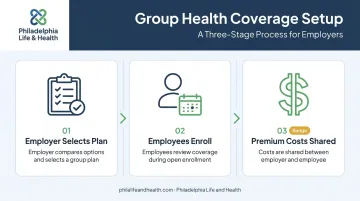
Here's how it works in practice:
- The employer selects the plan — choosing a carrier, plan type, and contribution structure
- Employees enroll during an annual open enrollment window or after a qualifying life event, such as marriage or the birth of a child
- Premium costs are shared, with the business typically covering a larger portion than employees
Because the risk pool includes everyone in the group, healthy and less healthy employees alike, carriers can offer lower per-person premiums than they would for an individual buying alone.
Group health insurance does more for a business than satisfy a compliance requirement. It works as a retention tool: when employees feel financially protected against a medical emergency, they tend to stick around longer, and that stability shows up in lower hiring costs down the line.
Why It Matters for Small Businesses
Small business owners often ask whether offering coverage is worth the cost and administrative lift. The data leans toward yes.
63% of small-business employers say health insurance is very or moderately important for recruiting and retaining employees, according to a 2023 NFIB survey. That number jumps to 94% among businesses already offering coverage, compared to 58% among those that don't.
Skip group coverage entirely, and a few predictable problems tend to show up:
- Higher turnover as employees leave for jobs with better benefits packages
- Difficulty competing with larger employers who can absorb higher premium costs
- Lost productivity from staff delaying care or working through preventable illness
This is where independent advisors earn their keep. Philadelphia Life and Health works with small and mid-sized employers across the 2 to 200 employee range, comparing options across five major carriers, including Independence Blue Cross, Aetna, Cigna, UnitedHealthcare, and AmeriHealth. This gives business owners a competitive benefits package without needing an in-house HR team to manage the process.
Types of Group Health Insurance Plans
Group health insurance isn't one product. Plans vary by network structure, how costs are shared, and how much flexibility employees get in choosing providers. Picking the right one means understanding the trade-off between cost control and provider access.
HMO (Health Maintenance Organization)
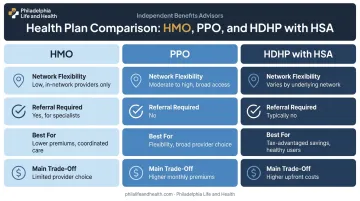
An HMO requires employees to choose a primary care physician and get referrals before seeing specialists. Coverage is generally limited to an in-network provider list.
- Best for: Budget-conscious businesses that want predictable monthly costs and a strong emphasis on preventive care
- Trade-off: Narrower provider choice and little to no out-of-network coverage, plus potential delays waiting on referrals
PPO (Preferred Provider Organization)
A PPO offers a broader provider network and doesn't require referrals to see a specialist. Out-of-network care is still covered, just at a reduced rate.
- Best for: Businesses with a diverse workforce that values flexibility and direct specialist access
- Trade-off: Higher premiums and more complex plan administration compared to an HMO
According to KFF's Employer Health Benefits Survey, PPOs remain the most common small-group plan type by enrollment, covering 46% of workers at firms with 10 to 199 employees, well ahead of HMOs and HDHPs.
HDHP (High-Deductible Health Plan) with HSA
An HDHP pairs a lower monthly premium with a higher deductible, and it opens the door to a Health Savings Account for tax-advantaged medical savings. For 2026, HSA contribution limits sit at $4,400 for self-only coverage and $8,750 for family coverage, per IRS Revenue Procedure 2025-19.
- Best for: Employers with a typically healthy workforce who want lower premiums and a tax-advantaged savings vehicle
- Trade-off: Higher upfront out-of-pocket costs, which can be a tough sell for employees who need frequent care
Group Health Insurance Eligibility, Costs & Requirements for Small Businesses
Eligibility rules trip up a lot of first-time buyers. Most carriers and marketplaces require a minimum group size and a minimum participation rate before they'll issue a policy.
Typical participation and size rules:
- HealthCare.gov's SHOP marketplace requires 1-50 full-time employees and at least 70% participation from eligible staff
- New Jersey's small-employer guide sets participation closer to 75%, plus a minimum 10% employer contribution
- Both requirements are commonly waived between November 15 and December 15 for open enrollment
Who Pays the Premium?
Cost-sharing is standard practice, but the split isn't 50/50. At small firms with 10 to 199 workers, average annual premiums ran $9,211 for single coverage and $26,054 for family coverage in 2025, according to KFF's survey. Employers covered roughly 84% of the single premium and 64% of the family premium, with employees picking up the rest.
Tax Credits Worth Knowing
Qualifying small employers may claim the Small Business Health Care Tax Credit, worth up to 50% of employer-paid premiums for taxable businesses. To qualify, a business generally needs:
- Fewer than 25 full-time equivalent employees
- Average annual wages below the IRS's inflation-adjusted limit
- A uniform contribution of at least 50% toward employee-only premiums
State-by-State Variation
Requirements shift depending on where your employees are located. Pennsylvania, New Jersey, and Delaware each apply their own definitions of a "small employer" and their own participation expectations.
This detail trips up business owners managing coverage across state lines. A locally licensed advisor like Philadelphia Life and Health helps employers navigate carrier options and compliance requirements across the PA, NJ, and DE markets without guesswork.
How to Choose the Right Group Health Plan for Your Business
There's no universally "best" plan. The right choice depends on your workforce, your budget, and how much administrative support you have on hand.
Factors to Consider
Weigh these factors together rather than individually, since trade-offs in one area often affect another; for instance, a lower premium may come with a smaller network.
- Budget tolerance per employee: know what you can realistically contribute before comparing quotes
- Workforce demographics: a younger team with fewer dependents may lean toward an HDHP; an older team may prefer PPO flexibility
- Provider network needs, especially if employees are spread across multiple states
- Administrative capacity: platforms like Ease can handle open enrollment, new-hire onboarding, and life-event changes without burying your team in paperwork
- Long-term flexibility to adjust plans at renewal as your business and workforce change
Common Mistakes to Avoid
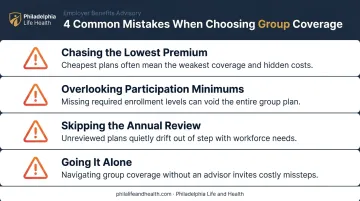
Business owners tend to repeat the same handful of errors when selecting group coverage:
- Chasing the lowest premium without weighing deductibles or network restrictions, which often costs more at the point of care
- Overlooking participation minimums required by the carrier or state before finalizing enrollment
- Skipping the annual review, leaving benefits stale as the workforce grows or shifts
- Going it alone and missing compliance deadlines or available tax credits — an area where working with an independent advisor such as Philadelphia Life and Health helps avoid costly errors
Conclusion
Group health insurance has become a genuine competitive lever for small businesses, directly shaping recruitment and retention outcomes. HMOs, PPOs, and HDHPs each solve for a different mix of budget and workforce need, and getting that match right matters more than picking whatever plan is most familiar.
Coverage decisions don't end at enrollment, either. Renewal reviews, compliance monitoring, and claims advocacy all happen year-round. Philadelphia Life and Health supports employers with 2 to 200 employees across Greater Philadelphia, Pennsylvania, New Jersey, and Delaware, offering that kind of ongoing guidance from initial plan selection straight through every renewal.
Frequently Asked Questions
What is the definition of a group health plan?
A group health plan is employer- or association-sponsored coverage purchased for a defined group of members under one policy. It's distinct from individually purchased insurance, where each person shops and enrolls separately.
What is the most popular type of group health plan?
PPOs remain the most common, covering 46% of workers at small firms in 2025, followed by HDHPs with a savings option at 26% and HMOs at 9%.
Who pays the premium in a group health plan?
Premiums are typically shared between employer and employee, with the employer usually covering the larger portion. Small-firm employers paid roughly 84% of single premiums and 64% of family premiums on average in 2025.
How many employees do you need to qualify for group health insurance?
Many carriers and marketplaces allow groups as small as one or two employees, though participation minimums and rules vary by state and carrier. Some states require the sole employee to work a minimum number of weekly hours.
How much does group health insurance typically cost for a small business?
Average annual premiums at small firms ran $9,211 for single coverage and $26,054 for family coverage in 2025. Actual costs vary by plan type, location, and workforce demographics.
How does group health insurance compare to an ICHRA for a small business?
A group health plan covers your whole team under one shared policy, while an ICHRA reimburses employees tax-free so they can buy individual coverage of their choosing. Very small teams often find an ICHRA offers more flexibility and predictable costs than a traditional group plan.