
Introduction
Being your own boss means no more asking permission for a day off. It also means no more employer picking up 70% of your health insurance bill.
You're not the only one facing this challenge. Freelancers, gig workers, and independent contractors now make up more than a third of the U.S. workforce, according to Upwork's Freelancing in America report. Each one faces the same problem: sourcing individual coverage without an HR department to lean on.
The stakes are real. Skip the wrong plan, and you're stuck with sky-high premiums. Skip coverage altogether, and one broken ankle could mean thousands in medical debt.
This guide breaks down your coverage options, how ACA subsidies work, the tax deductions available to you, and how local expert guidance can simplify the entire process.
Key Takeaways
- Options include ACA Marketplace plans, spousal coverage, COBRA, Medicaid, or health sharing
- Premium tax credits are available based on your household income and family size
- HSAs offer a triple tax advantage: deductible contributions, tax-free growth, tax-free withdrawals
- The self-employed health insurance deduction lets you write off 100% of premiums without itemizing
- A local independent broker compares plans at no cost, since carriers pay the fee
Why Self-Employed Workers Need a Deliberate Health Insurance Strategy
When you work for someone else, your employer typically covers a chunk of your premium before you even see the bill. When you work for yourself, you're paying the full sticker price. That single difference changes how carefully you need to shop.
The self-employed already make up a significant slice of the individual insurance market. According to KFF's 2024 CPS ASEC analysis, 48% of adults under 65 with individual-market coverage are self-employed, small-business owners, or work for businesses with 1-24 employees. In other words, you're not a niche case. You're the market.
Going without coverage is a bigger gamble than it feels like day to day. Uninsured adults under 65 are far more likely to carry medical debt than their insured counterparts:
- 34% of uninsured adults had past-due provider bills, compared to 26% of insured adults
- Under a broader definition including credit card medical debt, that gap widens to 62% versus 44%
There's also no HR department to catch your mistakes. No one is reminding you about open enrollment deadlines or flagging a missed subsidy. That responsibility sits entirely with you, which is exactly why a deliberate strategy matters more than a last-minute scramble.
Health Insurance Options for the Self-Employed
There's no single "best" plan for every self-employed person. The right choice depends on your income, your health needs, and whether a spouse's employer plan is even on the table. Here's how the main paths compare.
ACA Health Insurance Marketplace Plans
Marketplace plans cover all 10 essential health benefits, from prescription drugs to maternity care, and no insurer can deny you for a pre-existing condition. Enrollment generally runs November 1 through January 15, though a Special Enrollment Period can open the door outside that window.
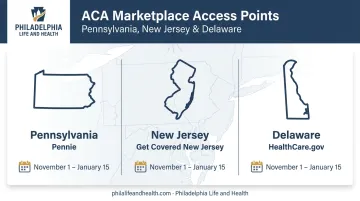
A regional note that matters for our clients: Pennsylvania, New Jersey, and Delaware don't all use the same system.
- Pennsylvania residents shop through Pennie, the state's own Marketplace
- New Jersey residents use Get Covered New Jersey
- Delaware residents shop through the federal HealthCare.gov
Coverage Through a Spouse's Employer or COBRA
If your spouse has employer coverage, you may be able to join their plan. Federal HIPAA rules require you to request enrollment within 30 days of losing other coverage, so timing matters if you're transitioning out of a job or a previous plan.
COBRA continuation coverage is the fallback if that's not an option. It lets you keep your former employer's plan for 18 to 36 months, depending on the qualifying event, but you'll pay the full premium (what you paid plus what your employer paid) plus a 2% administrative fee. It's rarely the cheapest option, but it preserves your existing provider network and deductible progress.
Medicaid, Short-Term, and Health Sharing Alternatives
Income-based Medicaid eligibility varies by state. In expansion states like Pennsylvania, New Jersey, and Delaware, adults generally qualify with income up to 138% of the federal poverty level. If your self-employment income dipped this year, it's worth checking before assuming you don't qualify.
Short-term plans and health sharing ministries can look attractively cheap by comparison, but neither is regulated like traditional insurance. Short-term plans issued after September 2024 are capped at a 3-month initial term and 4 months total coverage under federal rules, and insurers can medically underwrite applicants. Health sharing ministries are not insurance and don't guarantee your claim will be paid.
Treat both as bridge coverage, not a long-term replacement.
Understanding ACA Marketplace Costs, Subsidies, and Enrollment Timing
Marketplace premiums swing based on your age, location, household size, and the plan tier you choose. Costs have also been climbing. KFF found that the average amount enrollees pay after tax credits jumped 58%, from $113 a month in 2025 to $178 a month in 2026, according to KFF's 2026 Marketplace analysis.
As costs rise, who qualifies for help paying premiums matters more than ever. Premium tax credits generally apply to households earning 100% to 400% of the federal poverty level. The temporary rule that extended credits above 400% expired after 2025. Higher earners can now hit what's often called a "subsidy cliff," a sharp drop-off in assistance right at that income threshold.
Here's a detail people miss: your subsidy amount isn't based on the plan you actually pick. It's calculated using the second-lowest-cost Silver plan available in your area, then applied toward whatever plan you choose.
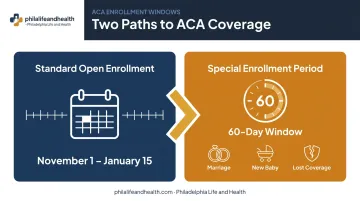
Your subsidy is only half the story. Two enrollment windows matter:
- Standard Open Enrollment — November 1 to January 15 in most states (Pennie and Get Covered NJ run slightly different windows, so check your state exchange)
- Special Enrollment Period — a 60-day window triggered by a qualifying life event, such as marriage, a new baby, or losing other coverage
Because your subsidy depends on projected income, estimate next year's self-employment earnings carefully. Guess too low, and you may owe money back at tax time. Guess too high, and you're leaving assistance on the table. Philadelphia Life and Health can help you run these numbers and confirm you're enrolling in the right window.
Maximizing Tax Savings: HSAs and the Self-Employed Health Insurance Deduction
Two tools do the heaviest lifting when it comes to lowering your real cost of coverage: the Health Savings Account and the self-employed health insurance deduction. They work differently, and it's worth understanding both.
The HSA Triple Tax Advantage
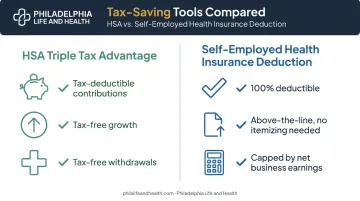
An HSA offers three separate tax breaks in one account:
- Contributions are tax-deductible, even if you don't itemize
- Growth inside the account is tax-free
- Withdrawals for qualified medical expenses are tax-free
To qualify, you need to be enrolled in an HSA-eligible high-deductible health plan (HDHP) with no disqualifying coverage. Enrolling in Medicare disqualifies you. A spouse's non-HDHP plan only disqualifies you if that plan actually covers you.
For 2026, the IRS set these limits under Revenue Procedure 2025-19:
| Limit | Self-Only | Family |
|---|---|---|
| HSA contribution | $4,400 | $8,750 |
| HDHP minimum deductible | $1,700 | $3,400 |
| HDHP maximum out-of-pocket | $8,500 | $17,000 |
Those age 55 or older can contribute an extra $1,000.
The Self-Employed Health Insurance Deduction
This one's an above-the-line deduction, meaning you don't need to itemize to use it. You can generally deduct 100% of premiums paid for yourself, your spouse, and your dependents on Schedule 1, Line 17, calculated using Form 7206.
A few catches to note:
- The deduction is capped by your net earnings from the business tied to the plan
- You can't claim it for any month you were eligible for a subsidized employer plan, even one through a spouse, even if you declined it
- If you're also claiming a premium tax credit, IRS Publication 974 has coordination rules you'll need to follow
One important correction to a common assumption: neither your HSA contribution nor your premium deduction reduces your self-employment tax. Both are adjustments to income on Schedule 1, applied after your net profit already flows to Schedule SE.
Why ICHRAs Don't Apply to Solo Business Owners
Beyond HSAs and the premium deduction, you may have also read about Individual Coverage HRAs (ICHRAs) as another tax-advantaged option. For most solo self-employed people, the answer is no: HRAs are structured for employees, so a sole proprietor without W-2 staff can't establish one for themselves. If you do have employees, that's a different conversation entirely, and one where ICHRA strategy actually becomes relevant.
Choosing the Right Plan and Getting Local Guidance
Picking a plan isn't just about the lowest monthly premium. That number is only half the story.
Compare these factors side by side:
- Monthly premium versus total potential out-of-pocket exposure (deductible plus max out-of-pocket)
- Whether your current doctors and specialists are in-network
- Prescription drug coverage, especially for maintenance medications
- Whether the plan qualifies for a premium tax credit based on your projected income
Weighing these factors takes more than a glance at HealthCare.gov's cheapest listing. Independent brokers are paid by the insurance carrier, not by you, so choosing one doesn't add a dollar to your premium. You still get comparison shopping across multiple carriers instead of one platform's limited view.
This is where Philadelphia Life and Health fits in. We're a locally owned, independently operated advisory firm based in Philadelphia and East Norriton, PA, licensed to help clients in all 50 states. For self-employed individuals across Pennsylvania, New Jersey, and Delaware, that means:
- Side-by-side plan comparisons across multiple carriers, explained in plain English
- Help understanding subsidy eligibility before you commit to a plan
- Year-round support, not just a sign-up-and-disappear service, including claims advocacy if a bill looks wrong or a claim gets denied
Reach out at (215) 544-5432 or info@philalifeandhealth.com for an individual coverage conversation. Most requests get a real recommendation the same business day.
Frequently Asked Questions
Are there free or affordable health insurance options for self-employed families in my state?
It depends on income. Medicaid may offer free coverage if your household falls within your state's eligibility threshold, and ACA subsidies can lower Marketplace premiums. Pennsylvania's Pennie also offers state-specific assistance beyond federal subsidies.
What is the best way to get health insurance if you are self-employed?
Compare ACA Marketplace plans, spousal coverage, and HSA-qualified HDHPs based on your income and health needs. A local independent broker can run these comparisons for you at no added cost.
Can I deduct health insurance premiums as a self-employed individual?
Yes. You can generally deduct 100% of premiums paid for yourself, your spouse, and dependents as an above-the-line deduction on Schedule 1. Health sharing ministry contributions don't qualify for this deduction.
Can I have an HSA if I'm self-employed?
Yes, as long as you're enrolled in an HSA-eligible high-deductible health plan and have no other disqualifying coverage, such as Medicare. Self-employment status itself doesn't affect eligibility.
Are health sharing plans a good alternative to traditional insurance for self-employed workers?
They can lower costs, but they're not regulated as insurance and don't guarantee your claims get paid. Pre-existing conditions are often excluded or limited, so weigh that risk carefully.
What happens if I miss the ACA Open Enrollment Period?
You'll generally need a qualifying life event, like marriage or losing other coverage, to trigger a 60-day Special Enrollment Period. Outside of that, short-term coverage can bridge the gap until the next enrollment window.